Περπατώντας Η μετάφραση θα είναι διαθέσιμη σύντομα
«Ξέρεις ότι είσαι ζωντανός /ή. Κάνεις τεράστια βήματα, προσπαθώντας να νιώσεις την στρογγυλάδα του πλανήτη ανάμεσα στα πόδια σου.» Annie Dillard
«Παίρνω και βγάζω περίπατο την ψυχή μου // κάθε που αρχίζει να σκληραίνει το χαμόγελό της. // Μου το λέει πεθύμησα τη βροχή, // τον ήλιο πάνω απ’ τα βουνά ή ανάμεσα απ’ τα σύννεφα // και τον αγέρα που γεννιέται αδιάκοπα στα δάση // όλος αρώματα και ουσίες, γάλα και μουσική.» Νικηφόρος Βρεττάκος
«Το περπάτημα στη φύση είναι η πιο βαθιά προσευχή. Κάθε βήμα κι ένα ευχαριστώ στον ήλιο και στο χώμα». Οδυσσέας Ελύτης
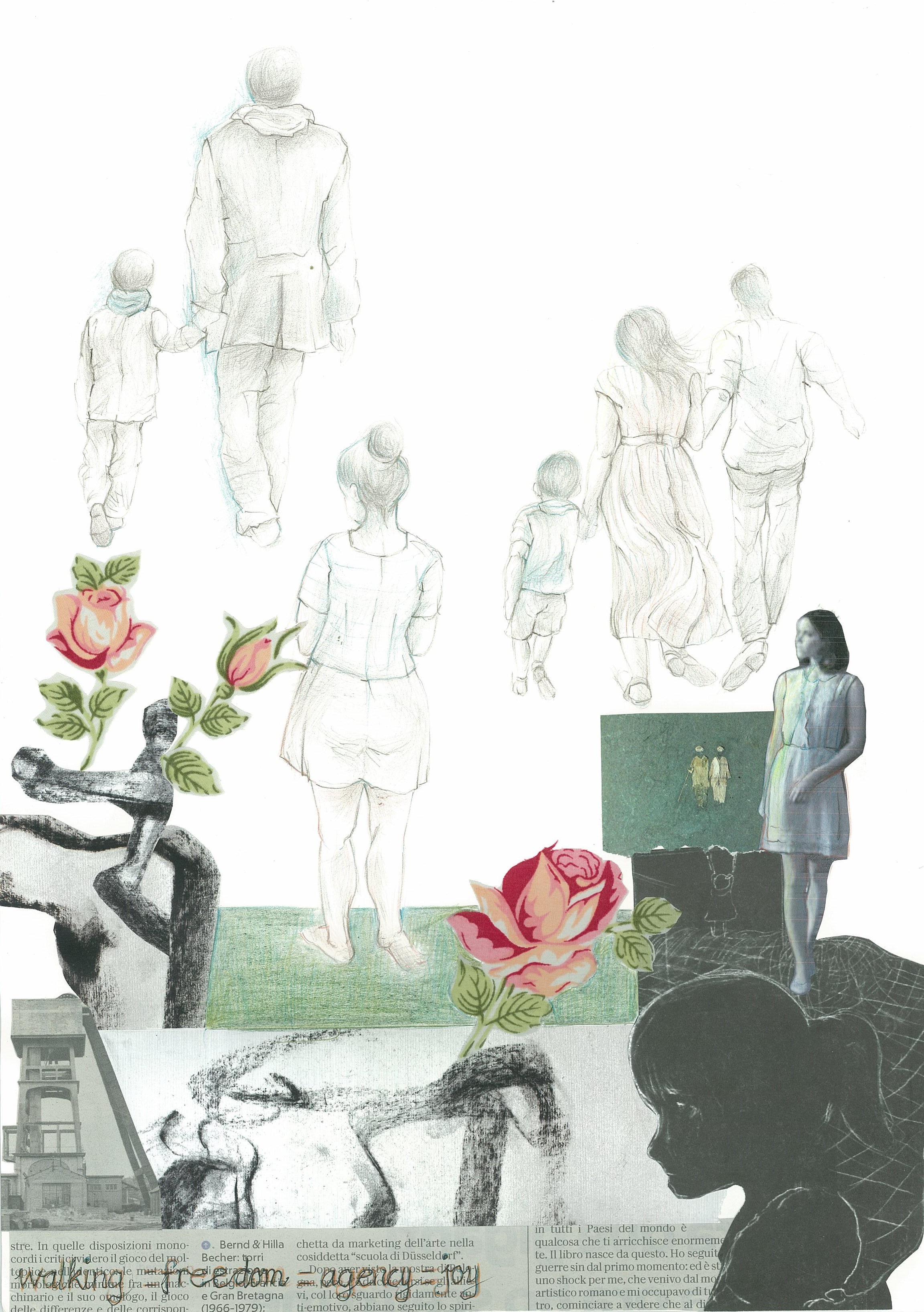
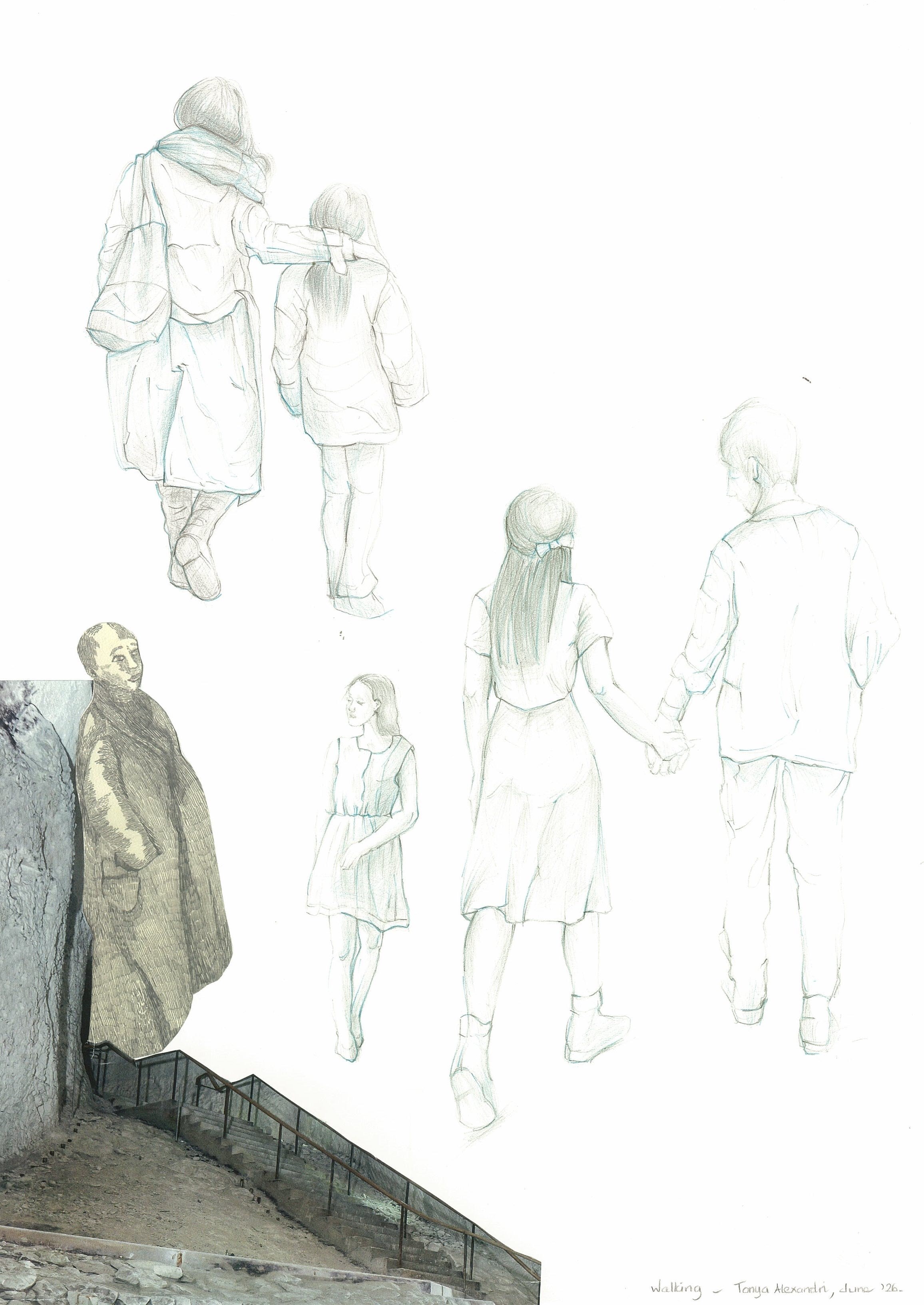
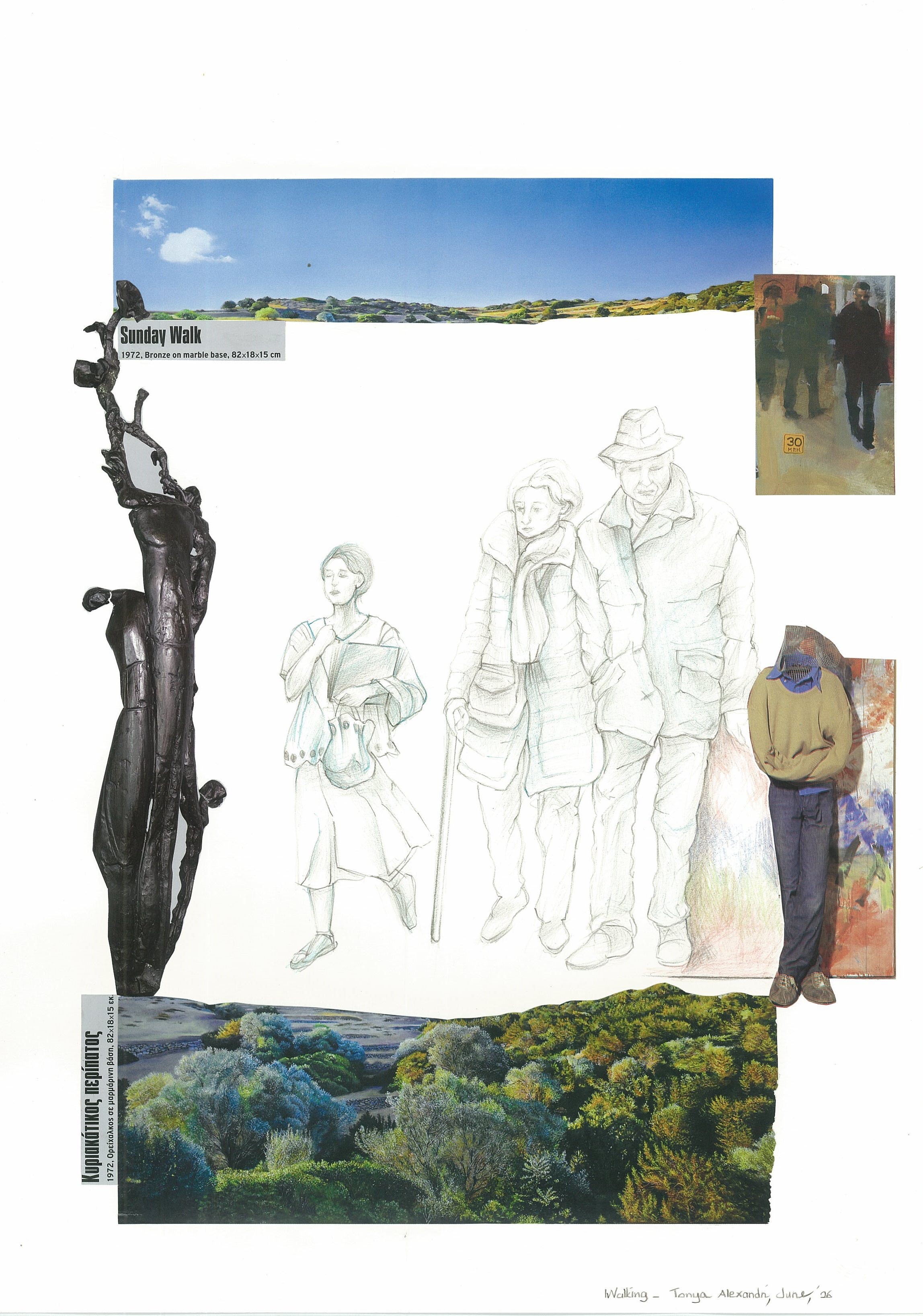
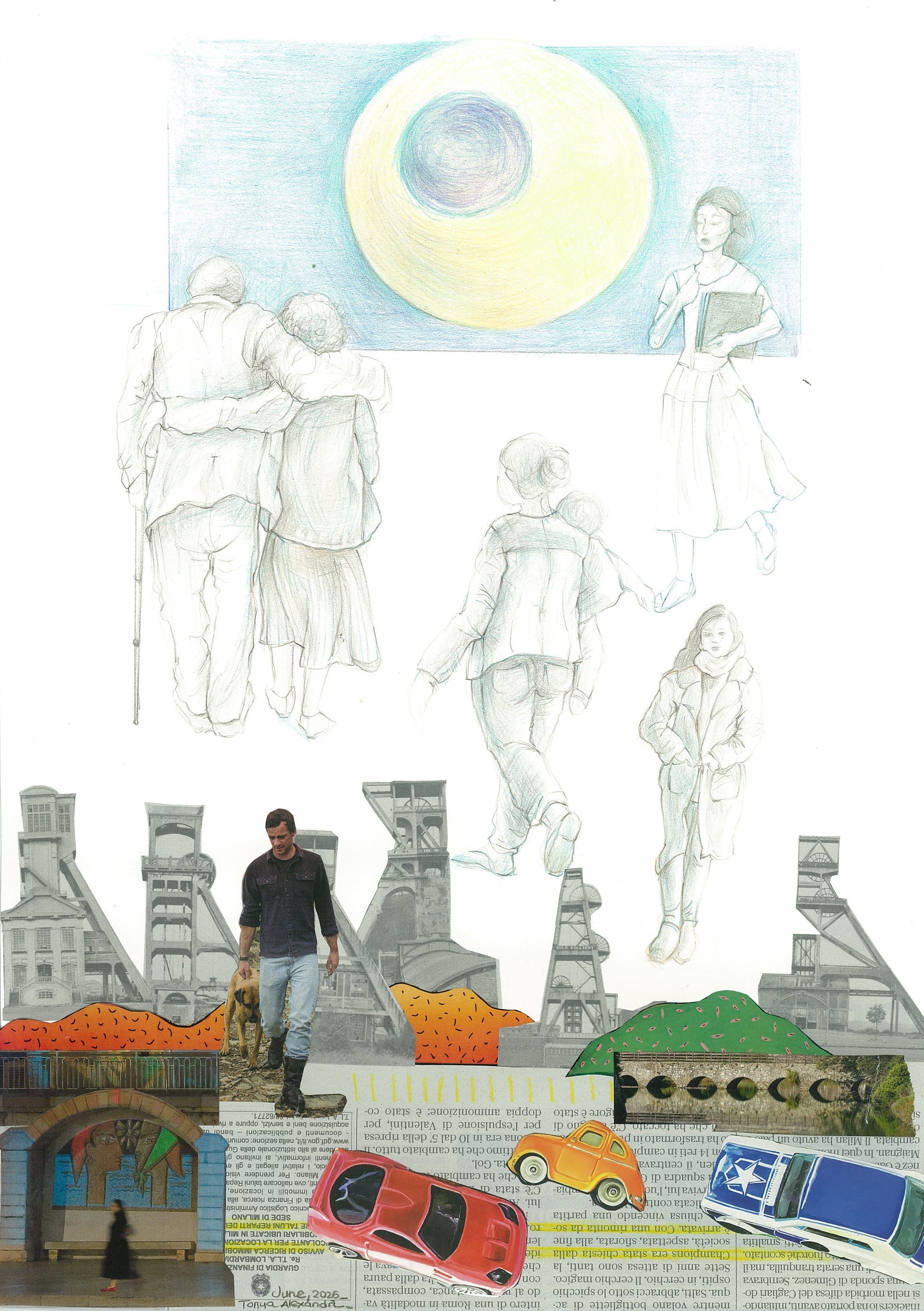
Η σημερινή ανάρτηση αφορά το περπάτημα, αυτή την έμφυτη ανθρώπινη ικανότητα να κινούμαστε στα δύο μας πόδια, διάσημους περιπατητές, και το βιβλίο του Frédéric Gros, A Philosophy of Walking / Μια Φιλοσοφία του Περπατήματος. Συνοδεύεται επίσης από τέσσερα σχετικά σχέδια-κολάζ που έφτιαξα ενώ διάβαζα κι έγραφα για το περπάτημα.
 Ο Ο
Ο Ο
Ο Frédéric Gros, γεννηθείς το 1965, είναι καθηγητής πολιτικής φιλοσοφίας στο Institut d’Etudes Politiques de Paris, διετέλεσε καθηγητής του Πανεπιστημίου Paris XII, δίδαξε στην Εθνική Σχολή Δικαστών, αλλά και στις φυλακές της Sante και της Fresnes, κι επιμελείται την έκδοση των έργων του Μισέλ Φουκώ. Επίσης, είναι ειδικός στην ιστορία της ψυχιατρικής και της βίας του πολέμου, και δεινός περιπατητής.
Ένας λόγος που επέλεξα να διαβάσω το βιβλίο είναι επειδή μου αρέσει το περπάτημα: για τα οφέλη που προσφέρει στην υγεία, για την αίσθηση ελευθερίας που μου δίνει και γιατί μ’ αρέσει να βρίσκομαι στη φύση,, για την ευκαιρία που μου παρέχει να παρατηρώ τον κόσμο, επειδή είναι ένας καλός τρόπος για να κάνω ένα διάλειμμα και μια εύκολη μορφή άσκησης, κι απλώς για την ευχαρίστηση του να μην κάνω τίποτα, πέρα από το να περπατάω κάτω από ανοιχτούς ουρανούς. Προσπαθώ να περπατάω αρκετές ώρες την εβδομάδα, και μερικές φορές περπατάω μεγαλύτερες αποστάσεις, αλλά δεν είμαι πεζοπόρος πολύ μεγάλων αποστάσεων ή ορειβάτης, δεν περπατάω ολόκληρες μέρες κι ούτε κατασκηνώνω στη φύση, όπως οι άνθρωποι που αναφέρονται στο βιβλίο, οι οποίοι περπατούσαν σταθερά και μ’ ένταση κατά τη διάρκεια της ζωής τους. Ένας άλλος λόγος που αγόρασα το βιβλίο ήταν ότι βρήκα ενδιαφέρουσα τη σύνδεση μεταξύ περπατήματος και φιλοσοφίας. Ο Gros καταφέρνει να υφάνει φιλοσοφικές ιδέες, βιογραφικά στοιχεία ιστορικών προσώπων και πώς το έργο τους συχνά συνδεόταν με το περπάτημα, ακόμη κι εξαρτιόταν από αυτό. Επιπλέον, περιλαμβάνει τις δικές του εμπειρίες και σκέψεις σχετικά με το περπάτημα τόσο στην ύπαιθρο όσο και σε αστικούς χώρους, και συνδυάζει την κοινωνικοπολιτική κριτική με μια γλαφυρή γραφή. Κάθε κεφάλαιο ξεκινά με μια σχετική εικονογράφηση. Ενώ το βιβλίο αποδείχθηκε ένα ενδιαφέρον ανάγνωσμα, γέννησε κι ορισμένα ερωτήματα, τα οποία με ώθησαν να διαβάσω περισσότερα σχετικά με άλλες ιστορικές προσωπικότητες για τις οποίες το περπάτημα ήταν σημαντικό.
Modern humans have walked the earth for about 300,000 thousand years, and our earlier human ancestors for millions of years. In some sense, our capacity to consistently walk upright has contributed to our evolution and defined our development trajectory as a species. I highlight species, because the fact that some people cannot walk due to health issues or disabilities, does not impact the evolutionary advantage of standing upright and walking. Across time thinkers and writers have been aware of the pleasure and the benefits of walking and climbing mountains and hills. Early Greek philosophers linked thinking to walking, and Aristotle founded the Peripatetic School [after the Greek verb περιπατείν, which means walking], a philosophical school founded in 335 BC in ancient Athens. Actually both Aristotle, who had the nickname, Peripatetikos (Walker), and Socrates used walking as a pedagogical process to think and teach, and like Socrates, Aristotle conducted his lectures while walking. The father of modern evolutionary theory, Charles Darwin, is also said to have built walking into his intellectual routine, and he took daily walks. Albert Einstein took long walks around Princeton, often barefoot. He noted: “I take time to go for long walks on the beach so that I can listen to what is going on inside my head.” The Danish existentialist philosopher discussed below, Søren Kierkegaard, loved solitary city walks, and had said: “Above all, do not lose your desire to walk. Everyday, I walk myself into a state of well-being & walk away from every illness. I have walked myself into my best thoughts, and I know of no thought so burdensome that one cannot walk away from it. But by sitting still, & the more one sits still, the closer one comes to feeling ill. Thus if one just keeps on walking, everything will be all right.” Ludwig van Beethoven took long daily walks with a pen and paper to write down inspirations for his symphonies. He was a nature lover, and walking helped him clear his mind and helped his creative process. Charles Dickens was also a passionate walker. In his biography of Dickens, Peter Ackroyd, says that he habitually walked twelve miles in two-and-a-half hours. Dickens wrote: “I am both a town traveller and a country traveller, and am always on the road.”.He often walked for hours during the night. These walks were an essential part of his writing because they allowed him to get acquainted with various parts of London, to absorb its atmosphere, and meet people from the grittier parts of the city.
In her book, Wanderlust, which I’ve referred to in an older post, Rebecca Solnit explores what it is like to be out in the world performimg the basic human action of walking. In presenting her topic she weaves stories and events, and diverse reasons to walk from religious pilgrimages and protest marches, to mountaineering, hiking and meandering. Solnit refers to philosophers, figures from literature, activists and others, and considers the interplay of our body and the world, and the freedom and pleasure that walking can offer us. Frédéric Gros, a long-distance rambler himself, in the same vein, includes others’ stories, interspersed with his own walking and hiking experiences, while pondering on why so many of the most productive writers and philosophers in history have all been avid walkers. He provides examples mostly from philosophy, literature, religion and political movements.
However, I was a little disappointed that women’s stories have not been included in this volume, since there have been famous women thinkers and writers since antiquity, who have been avid walkers and hikers, and who have actually written about their experiences. Of course, a book requires one to create an area of focus, and thus, it cannot contain everything. It’s inevitably influenced by the writer’s personal preferences and field of expertise, as well as, the fact that the topic of walking can be discussed in relation to many other themes. Moreover, including examples of women would have probably required a discussion about why women have mostly been omitted from this narrative and the reasons their voices have been ignored in walking literature, the societal restrictions that women (and marginalized groups, the elderly or individuals with disabilities) have faced, as well as, the issues of safety of walking alone in public that they often have conme up against. In her book, Wanderers: History of Women Walking, Kerri Andrews, a writer and hiker herself, focuses on ten famous women, and she describes the prejudice or threats endured by women for whom walking was important.
Gros has not even included women philosophers and literary figures like his compatriot, Simone de Beauvoir, or Belgian-French explorer, Alexandra David-Néel. Simone de Beauvoir (1908–1986), a renowned French existentialist philosopher, was also an avid hiker. In 1931 she embarked on long treks. Beauvoir writes about how she became attuned to her body and her surroundings, how she relished the physical exertion at the end of the day, and how her hiking in the mountains shaped her understanding of embodied subjectivity. Belgian-French explorer, Alexandra David-Néel, born in 1868, was the first foreign woman to explore Tibet. In 1924, at the age of 55, she disguised herself as a beggar and trekked across the freezing Himalayas and made her way to the holy city of Lhasa, which at the time, was forbidden to foreigners.
There are many more famous women. To mention, but a few European women only, Iris Murdoch, is also another important novelist and philosopher, who was an avid walker, and Virginia Woolf, the famed 20th-century author and essayist, took long walks through London and the countryside to sort through her ideas, and her walks shaped her writing and inspired her essay, “Street Haunting.“ Woolf believed walking alone was essential to women’s freedom and creativity. There are many female literary figures like Harriet Martineau (1802–1876), a 19th-century prolific writer, sociologist and abolitionist who extensively explored the Scottish Highlands and the Lake District on foot. In her book, The Living Mountain, Nan Shepherd, the Scottish writer and avid hiker, immortalized her physical and spiritual connection to walking. Jane Austen also liked to walk, particularly with her sister, and walking seems integral in her novels.
Many Greek women writers have also walked and climbed mountains since antiquity. One example, mentioned in the book briefly in the chapter on the Cynics, whose name derives from the Greek word for dog, κύων (kyon), is ancient philosopher Hipparchia the Cynic, born into a wealthy Thracian family, who married the Cynic philosopher Crates around 325 BCE, and adopted a lifestyle of voluntary poverty and being outsiders, discarand their possessions and the typical gender roles of the time. She attended symposia reserved for men only and debated philosophy in the agora, and walked and taught in the streets of Athens with Crates. Galatea Kazantzaki’s (1881-1962) experiences and adventures are reflected in her writing, and Elli Alexiou (1894-1988), writer and educator, walked and explored the places she found herself in, and integrated her observations in her writing. One contemporary historian and writer that comes to mind is Lena Divani, who has written a book, Τι έμαθα περπατώντας στον κόσμο / What I’ve learnt walking the world, which concerns her hiking and climbing adentures in places like New Zealand, Cuba, Ethiopia, Vietnam, Venezouela, India, Patagonia, and elsewhere.
However, to come back to the book, Gros includes an interesting chapter on the English poet William Wordsworth, who composed his long lyrical poems while walking, took to the road like a poor man, not through necessity but for pleasure, and, as Gros tells us, the incomprehension and hostility that Wordsworth encountered underlines the difference that exists between serious walking and the afternoon promenade that people of his class engaged in. In the late eighteenth century walking was mostly the lot of the poor, vagabonns or travelling showmen and pedlars. He quotes Christopher Morley who wrote that Wordsworth was one of the first to use his legs in the service of philosophy. In this chapter Gros does mention Wordsworth’s sister, Dorothy, but does not refer to her as the celebrated 18th-century diarist, who was also an avid walker and nature explorer, and who often accompanied her brother during his long walks.
Gros writes beautifully about walking and the joy and well-being it can bring, about hiking and trekking in more rugged landscapes to achieve a sense of freedom, about walking to facilitate thinking or to understand our primal human nature, about walking in urban and rural areas, in parks and in the wilderness, walking as a leaving and walking as a return, the pleasure of return and the pleasure of rest after a long walk, about religious pilgrimages, and protest marches and political disobedience, his own experiences, and more. He explores the meaning of walking, the different reasons and ways we walk, and he introduces us to philosophers, poets and writers, and other historical figures for whom walking was important and crucial to their work, and who sometimes engaged in it to the point of collapse. He urges us to remember the toddler’s bliss when taking their first steps and their eagerness to move on their own, and he invites us to examine our walking.
People walk for different reasons: for pleasure, for exercise, for its health benefits, to achieve a sense of freedom, for clarity, concentration and peace, out of necessity, out of a sense of adventure, to engage in exploration, as a form of escape, to think, to see the world, to celebrate, to protest and demonstrate, or in search of God. They walk for peace and they march in military parades. He considers how walking provides us the opportunity to go more slowly in a fast and full of distractions era, or the freedom that walking and sleeping outdoors, in a camp or shelter, for instance, allows us to experience, how it can help us escape our excessively sedentary and indoor lives. He discusses the benefits of solitary walking, the embracing of silence for a while and the experience of pleasure and well-being. He proposes that the monotony of bodily effort, the repetitive process, liberates the mind, and can both bring about calm and fuel the output of thought and creative work. This elemental practice, he says, gives us joy and pleasure, clears our mind and allows for awe and wonder, frees us and increases our sense of agency. He writes there is the suspensive freedom that comes by walking, and that even a simple short stroll allows one to “throw off the burden of cares…..escape the constraints of work, throw off the yoke of routine.” He also considers whether we also walk being aware at some level that old age might, and death will certainly strip us of the freedom to move.
Gros considers various cultural forms of walking like religious pilgrimages, and significant pilgrimage routes and sites in the world. Pilgrims walk for a variety of reasons he tells us, but what they have in common is that they walk, exert themselves, cut themselves off, leave lives and people behind, at least for a while. Pilgrims have historically taken to walking, often to distant destinations, for faith, to give thanks for a specific favour, to ask for intercession if a relative is sick, or if they themselves are seriously ill, or as a penance for very serious mistakes or sins, and in the past even for crimes that had gone unpunished, There have also been monks that spent their entire lives walking on narrow mountain paths. Some, he writes, can still be found in Mount Athos (in Greece). He also describes major routes and sites, which for Christians would be Rome, Jerusalem or Santiago de Compostela. Gross writes that behind every pilgrimage we can find a utopia and a story of internal transformation, of regeneration and of presence, or of rebirth through walking and enduring suffering. As an example of the utopia of rebirth through walking, for instance, he refers to the pilgrimage to Mount Kailash in Tibet, regarded by many Oriental religions as a holy place, and the centre of the universe. As an example of the utopia of cosmic rebirth, he writes about the great peyote walk accomplished annually by the Huichol people of Mexico, and where the objective of their pilgrimage is to reach Wirikuta, the Land of the Ancestors, where the peyote grows.
Walking can certainly have a political dimension, too. Gros discusses how systems and structures, such as class, capatilism, determine how, why or where we walk, but he avoids discussing how patriarchy, sexism, racism, marginalization of people, and forms of policing often also hinder the process of walking. He does however; demonstrate the link between walking and civil disobedience in various historical contexts. For instance, he refers to Gandhi’s political philosophy and practice. Gandhi walked and marched throughout his life in India, in Africa, in Europe, either as a preferred mode of getting about or as a way to reach people and engage them in peaceful protest marches. One example is the march for salt. The British had held a monopoly on harvesting salt in India and no one was allowed to trade in it or even extract some for personal use, and in order to achieve this, destruction of deposits took place when natural salt was found close to populations, who might take it for their own use.
Many vignettes are included in the book of philosophers, like Friedrich Nietzsche, who was a passionate and tireless walker, and walked both to relieve physical pain and to enhance his thinking capacity. He worked while walking or climbing mountains, composing some of his great works during these long walks. The 18th century philosopher, Jean-Jacques Rousseau, whose writing is filled with his walks, claimed he could not think and work without walking. His long search and walks in the woods in the second part of his life, writes Gros, led to his realization that “spite, suspicion and hatred aren’t rooted in primary savagery: they were grafted onto us, locked as we are in the world’s artificial garden, and have never stopped spreading since. That was the discovery of those open-ended walks.” He writes about Immanouel Kant’s routine walking. Every day the same stroll, at the same place, at the same time. His life, writes Gros, “was as exactly ruled as music manuscript paper.” His route through the park in Prussia, now Russia, came to be called “The Philosopher’s Walk.” Gros also writes about Henry David Thoreau, the author of Walden, a distilled account of his two years living in the forest, and of the first philosophic treatise on walking, and presents his ideas on walking, simplicity, frugality, wilderness, profit and benefit. Thoreau claimed that walking, for instance, might be of no profit, but it’s of great benefit.
Gros also writes about walking as a means of escape or as intertwined with melancholy. He includes an essay on the French poet, Arthur Rimbaud, and his fascination or rather intense urge to escape immobility, and comments that he finds in Rimbaud that sense of walking as flight. Rimbaud walked and travelled, obstinately and with passion. throughout his short life. He had said about himself: “I’m a pedestrian, nothing more.” Concerning Gérard de Nerval, Gros says that walking had become part of an active melancholia. He writes; “There’s a feeling of melancholy in Nerval’s attitude to walking.” There is also a chapter in the book about the societal pathologising of walking and pahthological forms of walking, like “dromomania” in the 19th century, labels that nowadays, he writes, have fallen out of favour.…. Today some of these cases might receive diagnoses like epileptic or dissociative episodes. Gros reflects: “It is interesting to ask why walking came to be pathologized in this way, and tempting to draw parallels with the contemporary criminalizing of vagabonds and vagrants,” and adds that authorities and respectable sedentary citizens have always been suspicious of intrepid walkers.And as we know, all authoritarian regimes curtail freedom of movement in public.
Gros refers to the monotony and repetitive nature of walking in various parts of the book, how the act of simply putting one foot in front of the other allows the mind to both wander and quieten. It frees the mind to be present, be still, to absorb and observe, and become aware of our.relationship with the landscape and our surroundings and the realization that we are part of it. He writes: “When we are walking, it isn’t so much that we are drawing nearer, more that the things out there become more and more insistent in our body. The landscape is a set of tastes, colours, scents which the body absorbs.” On writing about repetition he draws comparisons between walking and the process of chanting and repeating religious psalms. Similar to walking, he writes, the repetition of chants and religious psalms can lead to heightened concentration and peace. additionally, he claims that the slowness of walking allows us to notice, to see, to smell, to sense. He writes: “Repetition, slowness, gentleness: the walker too caresses the landscape for hours on end with their feet and eyes.” He talks about how “haste and speed accelerate time, which passes more quickly, and two hours of hurry shorten a day…… You can pile a mountain of things into an hour. Days of slow walking are very long: they make you live longer because you have allowed every hour, every minute, every second to breathe, to deepen….”
He also describes how walking can also be a momentarily escape from identity, as walking is a form of pure living. It provides a brief sense of escape and freedom and of leaving things behind, and brings about a tiredness that creates peacefulness. He writes: “…our complicated identities, our faces and masks. None of that can hold for long, because walking never calls for anything but the body……You are no longer a role, or a status……but a body, a body that feels sharp stones on the paths, the caress of long grass and the freshness of the wind.” Having nothing to do but walk makes it possible to recover the pure sensation of being, to rediscover the simple joy of existing, and there are instances after having walked for a length of time when the body experiences its own lightness. This loosening however of identity requires certain prerequisites, and it may not be possible for everyone in every context, especially in urban areas, where people may not always feel safe and where movement may not always be free of constraints.
In one of his more political chapters with the title, Walking Together, he writes: “Regimes simultaneously divide and unite. Being jealous of our neighbour and hating outsiders are two complementary urges that make us forget the original scandal….: the separation between rulers and ruled, rich and poor…….. Everything is bound together by brandishing the spectre of the enemy or outsider, creating a smokescreen and masking the unjust division of society.” There’s also a chapter on the relationship between walking and gratitude. Gros writes: “Epicurus has a word for this: kharis (χάρις)…… Kharis: I am the recipient of a gift, to which I respond with gratitude. The tourist in a hurry and the persevering walker do not see the same thing. The former takes, captures, records, accumulates and expands their database. The latter offers thanks and gives him or herself up to the experience.” There are more themes discussed in the book like walking as survival. He refers to Cormac McCarthy’s novel, The Road, the story of a father and young son’s journey on foot in an apocalyptic environment, where they have nothing to cling on but hope, their humanity and their love for each other.
Anther philosopher that is included in the book is Kierkegaard, who spent his life walking, thinking and writing, and wrote about how he saw that each ‘stage on life’s way’ implied a certain way of walking (the aesthetic, the ethical, the religious). Gros opens the chapter with a memory from Kierkegaard’s childhood or perhaps a metaphorical story. In any case, this story tells us of a child who wanted to go out in the street to run and play, and his strict and controlling father made him walk with him across a long room, up and down, up and down, on and on, while imagining and talking about the things they might have seen and encountered in the streets of Copenhagen.There’s also a brief reference to the trauma associated with the Corsair Affair, which influenced Kierkegaard’s thinking and work to further assert individualism in defiance of crushing societal pressures, to critique the role of the mass media, and the social process of leveling in which the uniqueness of the individual is rendered non-existent.
Towards the end of the book Gross writes about Proust and leisure strolls, the ones we took as children and the ones we take as adults to relax, in parks, on pavements and around our neighbourhood. He takes us back in time to Paris, when entry to the curated public gardens was originally denied to the rabble and only high society was allowed in, and also discusses the origins of the flâneur, the city dweller, who wanders without destination in a city, in order to experience it, to take in the sights, smells and the city scape. Gross writes, “The flâneur appeared at a time when the city had acquired enough scale to become a landscape. It could be crossed as if it were a mountain, with its passes, its reversals of viewpoint, its dangers and surprises too. It had become a forest, a jungle,” and adds that this form of strolling presupposes the presence of three conditions: the city, the crowd, and the reign of merchandise. In the final chapter on weariness and the reasons he walks, Gros says: walking “gently wears away at the body as if it were being polished, resulting in a radiant weariness.”