Ursula Le Guin’s writing
“This is the treason of the artist: a refusal to admit the banality of evil and the terrible boredom of pain.” From The Ones Who Walk Away from Omelas by Ursula Le Guin
Ursula Le Guin calls “writers who can see alternatives to how we live now, and can see through our fear-stricken society and its obsessive technologies, to other ways of being. We’ll need writers who can remember freedom—poets, visionaries—realists of a larger reality.”
“We will not know our own injustice if we cannot imagine justice. We will not be free if we do not imagine freedom. We cannot demand that anyone try to attain justice and freedom who has not had a chance to imagine them as attainable.” Ursula Le Guin
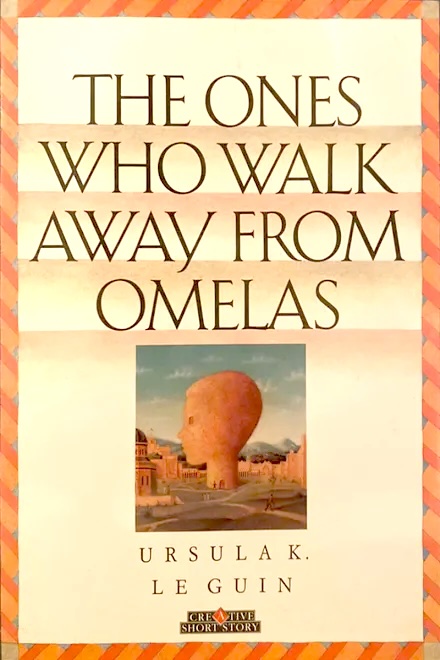
Α. The Ones Who Walk Away from Omelas by Ursula K. Le Guin
[It’s better to read the story without knowing much about it beforehand]
Today I’ll be referring to a short story / book by Le Guin (1929-2018), considered one of the great American writers and an important female science fiction writer. Winner of multiple literary awards, she also wrote essays, poetry and children’s books, and mainly science fiction, through which she interpreted and allegorically brought to light social reality, contradictions and social dynamics, and the technological and existential challenges of our species.
In 1974 The Ones Who Walk Away from Omelas won the Hugo Award for The Best Short Story. It is a short philosophical story that reads like an allegory or a fairy tale, and by the end of the narrative you realise that it’s one of those stories you will most likely never forget. The story is pure narration, there is no action or character development, and part of it describes the preparations for a summer festival, and the way this joy filled community is set up; however, it is also vague enough to give the reader room to consider their own utopia. It chronicles the lives of the inhabitants of Omelas, a utopian city, where everyone lives with ease, safety, and joy. Le Guin writes: “They were not simple folk, you see, though they were happy……..They did not use swords, or keep slaves. They were not barbarians. I do not know the rules and laws of their society, but I suspect that they were singularly few…… They were mature, intelligent, passionate adults whose lives were not wretched.” In this utopian land everything seems wonderful, except for one horrific detail. The happiness of everyone depends on the torment and severe suffering of a nine or ten year old child.
In the introduction of the book Le Guin tells us that the central idea of this psychomyth, the scapegoat, appears in Dostoyevsky’s, Brothers Karamazov, and in William James’s, The Moral Philosopher and the Moral Life. She notes that Dostoyevsky framed the question in religious terms, whereas, James framed it philosophically. She writes: “Dostoyevsky’s Ivan asks Alyosha (and us) “Would you consent to carry out the plan, would you accept the happiness, on that condition?” William James asks the same question: “…….. millions kept permanently happy on the one simple condition that a certain lost soul on the far-off edge of things should lead a life of lonely torment, what except a specifical and independent sort of emotion can it be which would make us immediately feel, even though an impulse arose within us to clutch at the happiness so offered, how hideous a thing would be its enjoyment when deliberately accepted as the fruit of such a bargain?
Her story also brought to my mind Shirley Jackson’s famous short story The Lottery, published in 1948 that depicts a small ordinary community conducting its customary annual lottery. This seemingly festive event culminates in the “winner,” or otherwise put the randomly selected scapegoat, being stoned to death by the rest of the villagers, everyone, including the children, who are given pebbles to throw at the victim. This story makes visble the following of tradition blindly, superstition and ignorance, fear of breaking a long held social ritual, societal comformity, and the capacity for violence by seemingly good and repectable people.
In Le Guin’s story the scapegoated child is locked up in an unlit basement. It sits naked in silence and filth, terrified of brooms and mops, fed just enough to remain alive. Sometimes it speaks: “Please let me out. I will be good!” The decription of the abuse and horrors the child faces is actually hard to read. This terrible fact is revealed to everyone in their childhood. Some people visit the child to witness the reality, but no one is allowed to interact with or show the child any kindness, for the sake of the collective happiness. It feels for a little while that Le Guin might even be trying to sway the reader into considering this kind of injustice and cruelty as necessary for the good of the majority. This feels all too true to the justifications and rationalizations made in real life.
Witnessing the child’ suffering impacts people differently, which also feels all too true to real life. Some are indifferent and even willing to contribute some more to the child’s suffering, most simply accept this sad necessity and learn to ignore it, even if they consider themselves good people, and as one can guess from the title, some cannot dissociate this knowledge or forget what they’ve witnessed. Their perception of their utopian city is shattered and they cannot bear the weight of living on the back of a tortured child. They are not willing to make the moral compromise. Le Guin writes: “At times one of the adolescent girls or boys who go to see the child does not go home to weep or rage, does not, in fact, go home at all. Sometimes also a man or woman much older falls silent for a day or two, and then leaves home.” They walk away, but we don’t know where they go or what they find there.
The story has been interpreted in several ways, and probably our interpretations are coloured by our beliefs and experiences, our culture and our readings. It seems fair to say that it refers to the societal practice of scapegoating and the price paid by many for the comfort of others. It could also reflect the community’s need to project its unhappiness, so as to sustain the prosperity of the collective. The fact that the laws of Omelas enforce the confinement of the child could also suggest that societal evil and injustice are institutionalized. Some ask whether the story points to the suffering of Jesus for the rest of humanity. Others suggest that it is pointing towards the way our socioeconomic and political systems are set up, where the happiness and comfort of many depend on the suffering of those outside the economy or political processes, where large numbers of people, children included, and communities, are casualties of unfair and cruel sociopolitical realities. Could it also be an allegory of the mind, the conscious aspects and the unconscious or undesired material pushed down and out of sight or the pain hidden in the basement?
Le Guin offers a profound look at the world and ourselves, and has, in some sense, created a mirror for readers, challenging them / us to think of what a perfect or just society would look like, and what we could accept or tolerate and what we would need to reject if we were to retain our humanity. Inevitably, the topic of guilt also arises, how to live with the guilt of knowing that one lives on the back of others that are suffering, what to do, what is realistically possible. In any case, at the end of our reading we are left with several questions without easy answers: Is a community that hinges on the suffering of one person a real utopia? Where do those who walk away from the city go? Are those involved in the scapegoating process free or are they tethered to their victims? Is the perpetuation of the practice of scapegoating really necessary for groups or societies to flourish or to be happy? What is good and what is evil? What is real happiness?
Β. In the previous two posts on scapegoating I didn’t manage to include references to certain contexts, like psychology training groups or classes, therapy, or group therapy in particular, where scapegoating frequently occurs, but can, if dealt in a skillful and ethical manner, and if the therapist is able to recognise and deter factors that threaten the cohesiveness of the group [e,g, consisrent absences and tardiness, scapegoating, disruptive extra group socialization and subgrouping], provide opportunities for differentiation, integration and growth.
One relevant article is Scapegoating in Group Psychotherapy by J. Kelly Moreno, PhD, at: https://files.core.ac.uk/download/pdf/32428352.pdf
An extract from the Conclusion part of the article:
“Scapegoating is ubiquitous. It occurs in couples, families, organizations and larger social systems. It also emerges in small groups, including psychotherapy ones. Unexplored and unanalyzed, scapegoating is destructive – through projective identification and other defenses one member evidences affects and behaviors that belong elsewhere. When these projections are not reclaimed, damage is done to the scapegoat and the group suffers in the depth and progress of the work. Initially, therapists may be tempted to join the group in targeting or attacking the deviant member. Indeed, as indicated above, some people are not strangers to the group’s projections and, consequently. the missives are easily absorbed. Effective leadership, however. will interpret how scapegoat behavior speaks to similar issues in other group members. In addition, skilled therapists will be able to help scapegoats move beyond a role in which they may be pathologically familiar.”
There’s also the issue of the scapegoating of women, the largest number of humans consistently scapegoated across time. In his TEDtalk Arthur Colman (see previous posts) briefly makes this point. I might return to this in a future post.
C. Finally, a few more things from Ursula Le Guin related to old age, the passing of time, change and diminsishing of things that I’ve been reading these last nine weeks since my father’s passing away at the age of ninety-nine. Being the second youngest he had lived through the death of all his siblings and wife. How did he deal with this reality within him? How did he feel about change, loss, the inevitable diminishing of things, and the nearing of the end of his cycle?
Two poems by Ursula Le Guin:
Ancestry
I am such a long way from my ancestors now // in my extreme old age that I feel more one of them // than their descendant. Time comes round // in a bodily way I do not understand. Age undoes itself // and plays the Ouroboros*……
*The term Ouroboros is derived from the ancient Greek words “οὐρά” (tail) and “βόρος” (that which eats/devours). It comes from ancient Egyptian iconography and depicts a snake or dragon eating its own tail, symbolizing the cycle of life and death, endless creation and destruction, and eternal rebirth.
Leaves
Years do odd things to identity. // What does it mean to say
I am that child in the photograph // at Kishamish in 1935?
Might as well say I am the shadow // of a leaf of the acacia tree
felled seventy years ago // moving on the page the child reads.
Might as well say I am the words she read // or the words I wrote in other years,
flicker of shade and sunlight // as the wind moves through the leaves.
In 2010, at the age of 81, Le Guin started a blog, inspired by reading Jose Saramago’s blog. Below is a snippet from her May 2013 post at: https://www.ursulakleguin.com/blog/tag/aging
“All I’m asking people who aren’t yet really old is to think about the ovenbird’s question** too—and try not to diminish old age itself. Let age be age. Let your old relative or old friend be who they are….”
** The ovenbird’s question (small songbird): What to make of a diminished thing? in Robert Frost’s poem, is a metaphor for how to deal with and make meaning of the inevitable loss, change, and decay in life and art.