December, 2025
“The young woman in front of me, with her little girl in the stroller, raises her head, smiles. She bends over towards the child. Look at the lights, my love!” Annie Ernaux
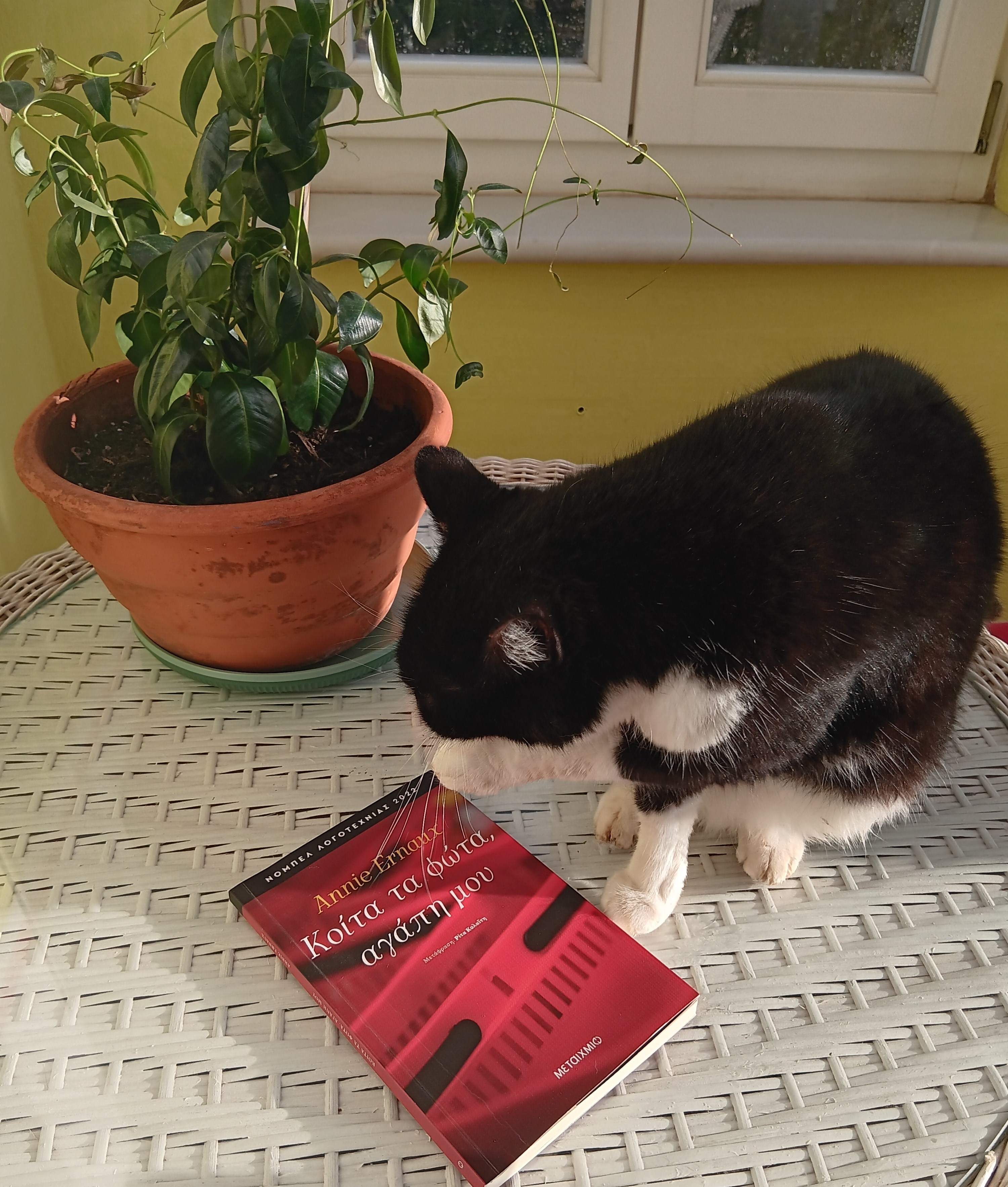
Today I’m posting something I started writing a little while ago, while I was reading the book presented below, but managed to finish today. The post is shorter than usual, but I’ve been doing things like having blood tests, dentist visits that I had neglected, and things around the house before the end of this year. The book I have written about is by French writer Annie Ernaux, Look at the Lights, My Love / Regarde les lumières, mon amour, and it’s about the hypermarket or supermarket, a space that Marc Augé defined as a “non-place.” The book is in the form of a diary, in which the writer records her thoughts, experiences and observations during her visits to her neighborhood Auchan store between November 2012 and October 2013.
The subject of her study is a “non-place” such as the supermarket, which the author transforms into a lens through which she examines and analyzes modern life, class and gender differences, social identities, consumerism, cheap labour in developing countries, and other realities and issues.The term “non-place” coined by the French anthropologist, Marc Augé, refers to spaces of transience where people remain anonymous, and that do not hold enough significance to be regarded as “places” in their anthropological definition. Examples of non-places would be airports, motorways, shopping malls, supermarkets, waiting rooms, etc. According to Augé, the concept of non-place, where people remain anonymous, differs from the notion of “anthropological place,” where they can meet other people with whom they share social references, and which offers people a space that empowers their identity.
In this book, as in her other books, Ernaux is courageous, insightful, questioning, and always connecting the personal with the political. Her narrative seems to repeat itself, perhaps reflecting the cyclical and repetitive nature of buying and seasons. She does not simply describe, but gives us a testimony of a specific context within a specific time. She records, interprets and analyzes. She tells us that perhaps the spirit of the times decides what is worth remembering, and that only recently have supermarkets been considered spaces worthy of representation in art, even though “…. there is no other space, public or private, where so many people so different in age, income, culture, geographical and ethnic origin, look, move and mingle.”
The book consists of diary entries in which the author records her observations about customers, employees, cashiers, who stand and scan products endlessly like a kind of production belt, the display cases, the products: food, toys, clothes, electronics, books and detergents, prices, commercial traffic during various periods of the year, but also issues related to downsizing and unemployment, the ethnic groups and immigrants she encounters, the organization of the aisles, advertisements, discounts, promotional products, the transformation of holidays into commercial functions, and the small daily human dramas.
For Ernaux, this anonymous space reveals issues of economy, power, gender, desire, and workplace hierarchies. She writes: “The supermarket is indeed crossed by History……. Sociocultural history of taste and fashion, of technology. Geopolitical history of migrations….” She does not only observe others, but situates herself in her narrative, analyzing her purchases, checkout choices, and the brands she chooses. In doing so, she reflects on class, ethnicity, and gender identity. She knows that the supermarket is also a gendered space, where women are often responsible for household or family shopping. Ernaux analyzes the class dimensions of the context she investigates, describing how the contents of the trolleys or baskets reveal social and financial status, and ethnic identity, and how some products signify deprivation and others prestige. She observes how the stalls with discounts and offers attract specific social groups.
She also describes the waiting time at the checkout, where we are very close to each other, observed and observing. The items we leave on the conveyor belt reveal not only our income, but also our eating habits, the structure of our family or household, whether we have pets or not, our interests and habits, our agility or our clumsiness, our kindness and concern for others or our indifference. And when an unknown woman recognizes her, then she feels herself becoming an object of observation and curiosity, as each product in her basket reveals elements of her habits and preferences, her own way of life. The supermarket thus becomes a place where we are all potentially exposed to the gaze of others.
Towards the end of her narrative, Ernaux also talks about the charm of these large shopping spaces and the collective life that unfolds in them, and which may in the future be lost with the spread of online ordering and delivery to the customer’s door. And perhaps today’s children, as adults, will miss Saturday shopping at the super market, just as those over a certain age miss the grocery stores of their old neighborhood. Ernaux’s parents owned a small grocery store and this was a significant part of her childhood and adolescence.