The Unkown Terrorist by Richard Flanagan
“In listening to what Chopin could not explain, she heard an explanation of her own life. Love is never enough, but it is all we have.” From The Unknown Terrorist by Richard Flanagan
Experience is but a moment. Making sense of that moment is a life.” From Question 7 by Richard Flanagan
Chekhov believed that the role of literature was not to provide answers but only to ask the necessary questions………. And why do we do what we do to each other? That’s question 7.” From Question 7 by Richard Flanagan
It’s only recently that I’ve discovered Australian writer, Richard Flanagan’s work, and have so far read two quite different books by him, Question 7, which progresses like a nuclear chain reaction, and blends history, literature and memoir in a beautifully rendered prose, and The Unknown Terrorist. In this piece I will be writing about The Unknown Terrorist, which reads a lot like a cinematic paced political thriller with enough suspense for the reader to keep turning the pages, but it’s more than that, and one could say it is a societal critique and a tragedy, in the sense of one event leading to or generating the next till the breaking, explosive point, like an unraveling of a tapestry. From the beginning we get the sense of inevitability and though we hope for the redemption of the protagonist, almost wanting to step into the story and save her, we know that things will probably turn out badly. There is no catharctic end, but one could perhaps see the ending as a kind of metaphor, suggesting that along with the destruction of the scapegoated and victimized comes the downfall of the perpetrator, at least the one who set the thing in motion. One could perhaps view it as a kind of justice, but ultimately, human lives, the possibility of living better and the possibility of justice or change are wasted all around.
To begin with the title itself is interesting, and perhaps implicit in the title is the idea of The Unknown Soldier, a commemoration of all the missing and unidentified soldiers lost in wars that were not of their own making or choice. There is also a philosophical, political and moral underpinning to the surface layer of the narrative, and Flanagan seems to be nudging us to reconsider the meaning of life, the disconnection from ourselves, others and nature, current harsh sociopolitical realities, unchecked power and greed, racism, terrorism, exclusion from the promise of a future and the means by which a future is possible, democracy and why individual freedom, love and the truth really matter and safeguard us from tyranny. He reveals how the News, and the media more broadly, can manipulate the population, construct our sense of identity, who we are and how we think, how they can be a vehicle to keep people numb, fearful and compliant, and how it is possible that anyone of us could be villainised and our life destroyed through the need to create scapegoated objects, avatars of social fear.
The book is also about loss, and in particular, the loss of love, in its many forms and in its broadest sense. It’s about the loss of caring, empathy and connection in society. The phrase, ‘love is not enough’ is repeated throughout the novel, which could be understood in different ways and applied to different contexts. It recurs like a koan or question the reader needs to confront. Ιn one instance Flanagan describes a scene where the Doll is observing a mother with her young child. He writes: “And the Doll had the overriding sense that, though she was full of many faults, she, like the Vietnamese woman and her son, was love. But for reasons that were not clear to her they would not let her love. Whatever it was—life, the world, fate—it had not let her love……. Then they lied to the world that she was hate, and deserving only of hatred. Hate was to be hunted with hate and, when found, destroyed.” As the story unfolds the reader slowly glimpses at the reasons the protagonist has not been allowed to love what she has wanted to love and why the process has always been disrupted.
The protagonist of this story is Gina Davies, a 26 year old pole dancer, mostly known and referred to throughout the book as the (Russian) Doll. Her being a pole dancer is an interesting choice, and it makes visible the ease with which people will make immediate negative judgments, and it also makes us realise how wrong these stereotypical judgments can often be. The Doll is a “westie,” from the wrong side of the tracks, from a non well off, somewhat dysfunctional family. She works over time and is saving money to go to college to obtain an education and to raise enough money for a downpayment on a flat in a nicer, safer neighbourhood. In her free time she reads decorating magazines or hangs out with her friend Wilder and her young son. When things get tough she copes by using pills and buying classy clothes, which in some sense transport her to her imagined future life.
Her life is disrupted violently when she is wrongly accused of being a terrorist.We follow her plight and the unravelling of her life over 4 days till her breaking point. Flanagan describes this string of events with realism and detachment. Without being aware the Doll is sucked into a vortex, which begins when she starts an affair with an attractive young man of Middle East origin. Initially she meets him on Bondi beach when he saves her friend’s young son and later that day in a carnival like celebratory parade in the city. He’s a computer programmer and a small time drug dealer, who is also wrongfully identified as a terrorist while Sydney is experiencing a minor terrorist scare, and soon after is found murdered in the street. A security camera video of the two of them embracing outside his apartment block results in her been constructed as the Unkonwn Terrorist. She becomes the target of a sleazy and vindictive, TV journalist-broadcaster, who is a regular client at the club she works, in Sydney’s red light distric, frequented by businessmen, media personalities, politicians, and others. He constructs the story based on flimsy evidence, like this misleading video footage, even though he knows that the narrative is problematic and that it’s not the first time he has destroyed someone’s reputation.
Over these four days she is constructed as something other than who she really is. She is being manipulated by the image of reality represented by the media, which in a dystopian way has displaced her real self. The Doll realises with terror that they were “turning her from a woman into cartoons, headlines, opinions, fears, fate. They were morphing her pixel by pixel….., into what she wasn’t.” She becomes the site for others to project their contempt, anger and fear, and above all an object that triggers a chain reaction of events that serve the agendas of people with vested interests, much more powerful than her, who are connected with each other because “at some deeply buried place,” they “understood that to share power was to share guilt.” She has unwittingly become the innocent lamb in the social slaughterhouse, and the biggest irony in the novel is that there are instances where the Doll buys into the fear, the xenophobia and racism, adopting opinions she hears on the News without processing them much.
The theme of societal scapegoating is one of the themes that run through the narrative, and the hunting down and elimination of the Doll remind us of ritual killings, viewed as a necessity, in older societies. From a certain point on her elimination is the most convenient thing for those implicit in the construction and the dissemination of the story. She becomes a public enemy and a useful scapegoat for politicians, and she is hounded by the media, let down by her good friend, whose loyalty is tested when she is threatened and forced to consider her son and her own safety, by the one policeman that is trying to protect her, and by people with authority, and power, who also realise she’s innocent, but are afraid to go against a network and a system they are part of.
During these four nightmarish days the Doll relives her past traumas and wounds, visits the children’s graveyard back in her hometown, where her baby son has been buried, cleans the small patch of land and leaves some flowers, runs out of money, shaves her long hair, always on the run from the police, the media, the newspapers, and anyone who might identify her. Everything has been taken from her: her identity, her privacy, her dignity, her dreams, her past and experiences have been distorted and sensationalised, her hard earned savings, stashed in the ceiling of her dingy flat in Darlinghurst because she has no bank account. While she undergoes this kind of Kafkaesque experience, she awakens to more reality, to what is going on and to how the world works behind the scenes:
“Maybe,” she thought, “there was some need people had to hurt others, some horrible need, that hurting one woman in some way might make others feel safe and good and happy…… And maybe she had to accept that she should be hurt, that maybe these things happen for the common good?” But then she thought, “She couldn’t accept that she should be hurt, she couldn’t just give in and give up.” She wonders if the “terrorism question” had become a fad, like fashion or Botox that hides the truth, and that there was a class of people who “were building careers, making money, getting power and it really wasn’t about making the world safer or better at all.”
This political thriller raises concerns about societal fear, racism and xenophobia, exclusion and the violence that it can potentially generate, the power afforded to governments and other authorities, and the activities involved in the name of protecting or controlling populations. The narrative is not balanced [reality is broader and more diverse] because it’s a novel and Flanagan is bringing to the foreground one part of the story, the hidden or half hidden reality of what goes on or could potentially go on behind our backs, with great intensity. He’s trying to make us aware of the risk of becoming more vulnerabile to forms of tyranny, if we’re obliviously ignorant, and all we are exists only within the confines and parameters of a system that we don’t have much control over.
It depicts a dystopian urban scene in Australia, where life is heavily defined by obsessive use of technology, the influence of the media, the pursuit of power and money, greed, consumerism, and the contrast between wealth and poverty.The novel is inhabited by many angry, desperate, disconnected people, homeless people sleeping in alley ways, beggars, drug addicts and dealers, pimps and crooks, and strip clubs, where those at the bottom mingle with those at the top, who have power, connections and money. This part of Sydney is not the iconic, happy, sunny land, but a place hit by heatwaves, freak storms and terrorist threats, where the public is numbed by shopping, alcohol, drugs and TV shows, and where a ceaseless noise of terror alert News breaks and fear push everyone closer to the edge.
We feel the writer’s anger as he presents us with the harsh side of the reality of injustices and abuses in a first-me society, where the powerful and well connected control and use, and the rest have to fend for themselves as best they can. Flanagan seems to be greving the loss of a world he has known of more social cohesion, of family ties, and of solidarity, which has been replaced by disconnection and social dislocation, and obsessive materialism and individualism. He shows us the bleakest parts of life in a dystopian Sydney, “a place that had once been a community, in a country that had once been a society.”
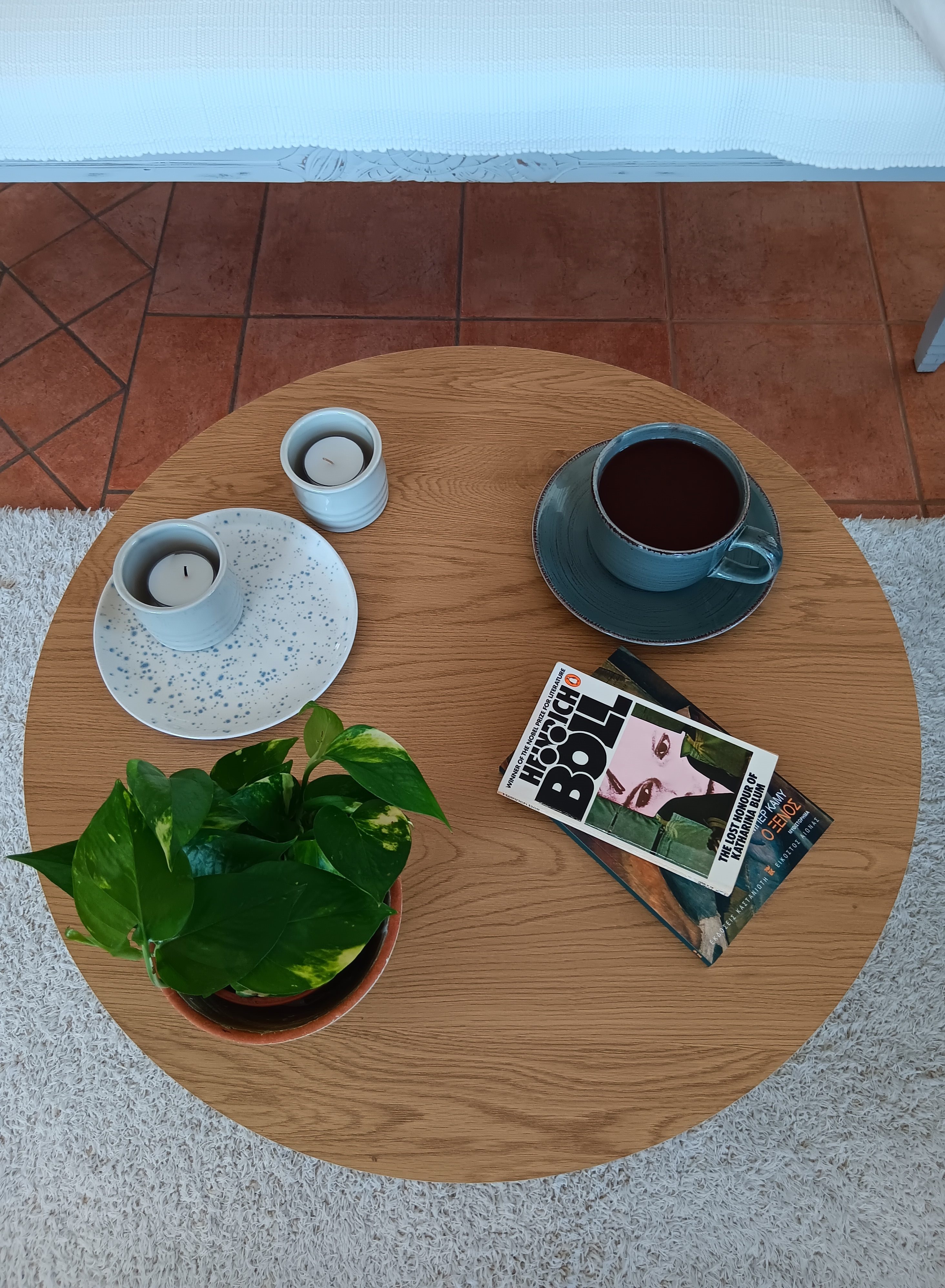
Αt the end of the book Flanagan acknowledges his debt to Heinrich Böll’s book, The Lost Honour of Katharina Blum. Although this book is different I felt it echoed Heinrich Böll’s story, which I had read in the very late seventies. I skimmed through the book, an old Penguin edition I still have, and I re-watched the film made by Volker Schlöndorff and Margarethe von Trotta in 1975 to refresh my memory. Both writers explore the same concerns about individual freedom, the role of the press, democracy, and how the “war on terror” can be used as an excuse to oppress and to undermine individual freedom and freedom of expression. The film was made in 1975 and it reflects the fear for civil liberties in West Germany during that period. Flanagan moves his story from West Germany in the 1970s to a post 9 /11 world, in Sydney.
Also, both writers have chosen female protagonists, which win readers’ sympathy or at least I would like to think so. The Doll is a good person, as was Katharina Blum, and although they do different jobs [Katharina is a housekeeper], they work hard, have similar aspirations of improving their lives, and share a similar class and family background. Gina Davies is known as the Doll and Katharina is sometimes called the Nun. They are both wrongly accused of being terrorists and both become victims of ruthless journalists / the press, they suffer smear campaigns and violations of privacy, and are finally pushed to the edge. They are also both let down, by people they know, and also institutions. Katharina, for instance, finds out that the institutions she turns to and had expected to help her don’t respond, and people she barely knows or strangers display hostile and threatening behaviours. She essentially finds herelf locked out of society. Two more similarities are that both stories take place over a four and five day period and utilize a carnivalesque, dancing and celebratory backdrop.
******************************************************************************************
Brief biographical notes
Richard Flanagan, born in 1961 in Tasmania, Australia, is a novelist, historian, journalist and film director. He left school aged 16, later earned a B.A. in history from the University of Tasmania, and in 1984 won a Rhodes scholarship to Oxford University, where he took a Master of Letters degree. He is widely considered the finest Australian writer of his generation. Flanagan and his wife live in Tasmania, and they have three daughters.
Flanagan has written several novels and in 2013 he released The Narrow Road to the Deep North, which was based in part on the experience of Flanagan’s father as a prisoner of war during World War II, and which received various honors, notably the the Booker Prize. He is also an award-winning journalist, on subjects including art, literature, politics and the environment, and is an ambassador for the Indigenous Literacy Foundation, to which he donated his $40,000 Australian Prime Minister’s Literary Prize prize money in 2014. In 2011 a collection of non-fiction writings was published as And What Do You Do, Mr Gable? In 2015 he published Notes on an Exodus, on the Syrian refugee crisis, which came about after visiting refugee camps in Lebanon, Greece, and meeting refugees in Serbia. The book features sketches made by Australian artist Ben Quilty, who travelled with Flanagan. He has criticized the Tasmanian government’s logging and gambling policies and relationship with corporate interests, and in 2021 published a non-fiction book, Toxic: The Rotting Underbelly of the Tasmanian Salmon Industry. In the BAFTA award-winning BBC documentary on Richard Flanagan, Life After Death [https://vimeo.com/135694839], Flanagan talks about several of his books, including, The Unknown Terrorist, and how certain personal experiences of political pushback influenced him to write this book.
Heinrich Böll (1917-1985) was a German writer and pacifist, winner of the Nobel Prize for Literature in 1972, and he remains one of Germany’s most widely read authors. In 1938 he was called into compulsory labour service, and he served six years in various fronts. Böll’s wartime experiences of being wounded, deserting, becoming a prisoner of war were central to his writing. Böll lived through the end of the war in the Rhineland, where he temporarily deserted and went into hiding with his wife, but fearing that he would be found, court-martialled and shot as a deserter, he rejoined the army at the end of February 1945. Shortly afterwards he was captured by American troops, and remained a POW until September 1945. That same year his first son Christoph was born, but died shortly afterwards. Böll and his wife went on to have three more sons. They have two surviving sons.
About the war experience he wrote: “frightful fate of being a soldier and having to wish that the war might be lost.” In Britannica it is stated that “Böll used austere prose and frequently sharp satire to present his anti-war and nonconformist point of view. He was widely regarded as the outstanding humanist interpreter of his nation’s experiences in World War II,” and due to his writing about the complexities and problems of the past, “some called him the Gewissen der Nation (“conscience of the nation”), a catalyst and conduit for memorialization and discussion in opposition to the tendency toward silence and taboo” (Wikipedia). In his work The Lost Honour of Katharina Blum the journalistic ethics of the time are critiqued as well as the values of contemporary Germany. Böll loved Ireland, and he and his wife had a second home there, which later became an artist’s retreat.