Edited on March 20th, 2026
Women, art and art history, rendering human life disposable, the birth trauma or “the primal wound,” family systems and theory…..
“Today it is particularly senseless that the meaning of war and its horror–as well, obviously, as its terror–should still be entrusted to the perspective of the warrior….The civilian victims, of whom the numbers of dead have soared from the Second World War on, do not share the desire to kill, much less the desire to get killed” (Adriana Cavarero)**
Today’s piece contains a few recent drawings, and a variety of topics that I’ve engaged with or reflected upon these past few weeks, while pondering on what has been taking place in the Middle East and elsewhere, which have brought, scholar, writer and cultural critic, Henry Giroux’s arguments to the foreground:
“Conservative and liberal politicians alike now spend millions waging wars around the globe, funding the largest military state in the world, providing huge tax benefits to the ultrarich and major corporations, and all the while draining public coffers, increasing the scale of human poverty and misery, and eliminating all viable public spheres – whether they be the social state, public schools, public transportation or any other aspect of a formative culture that addresses the needs of the common good.”
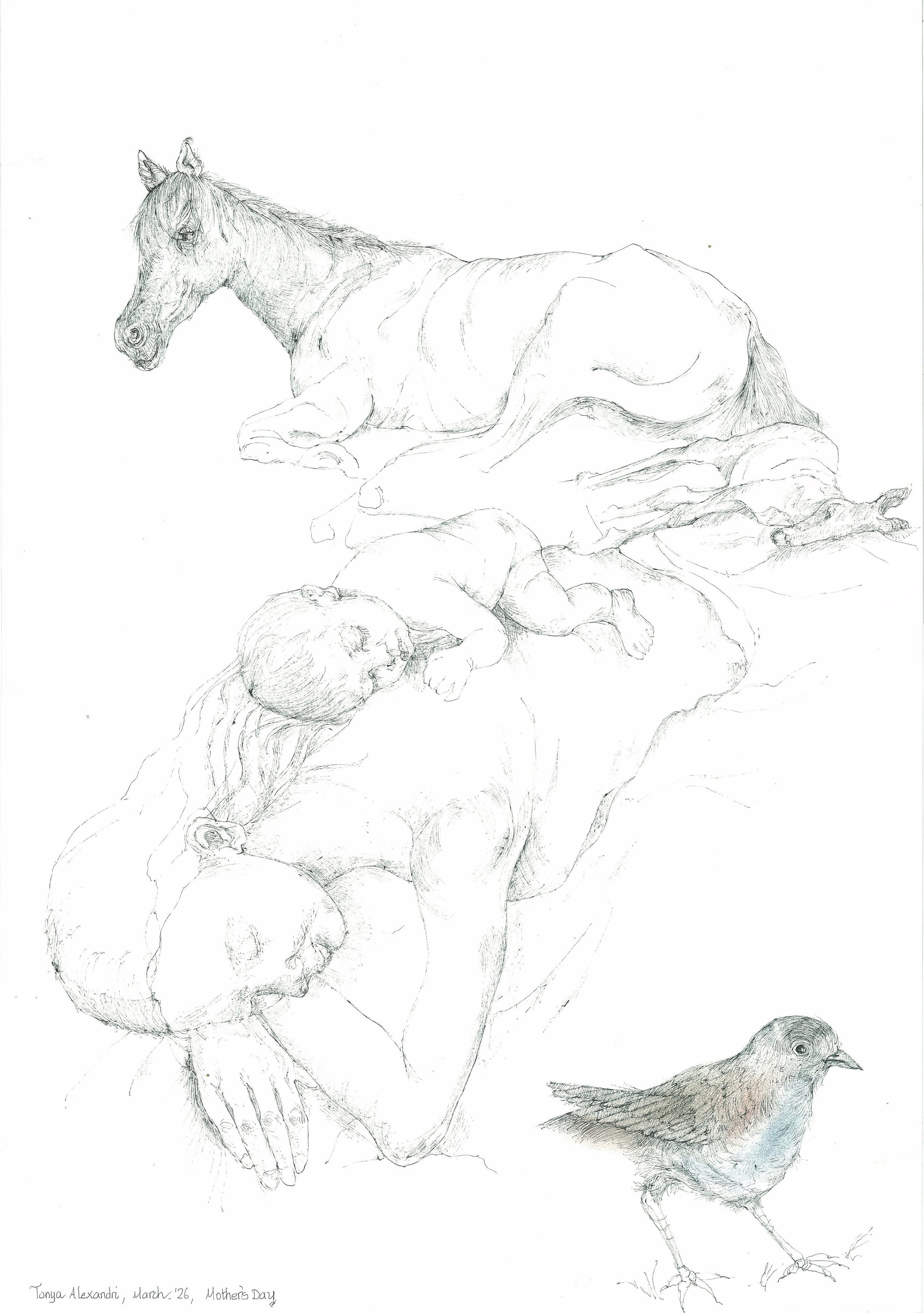
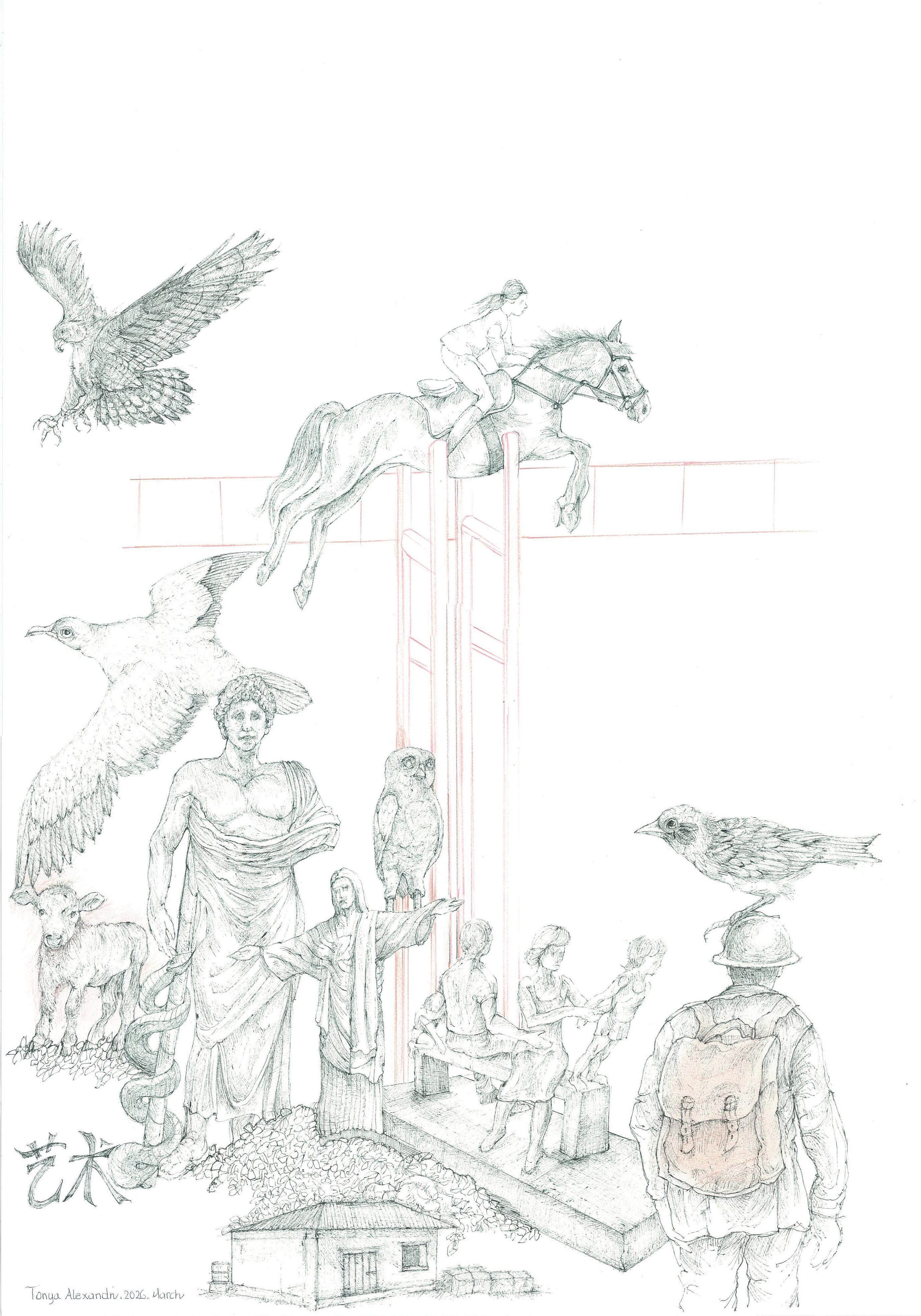
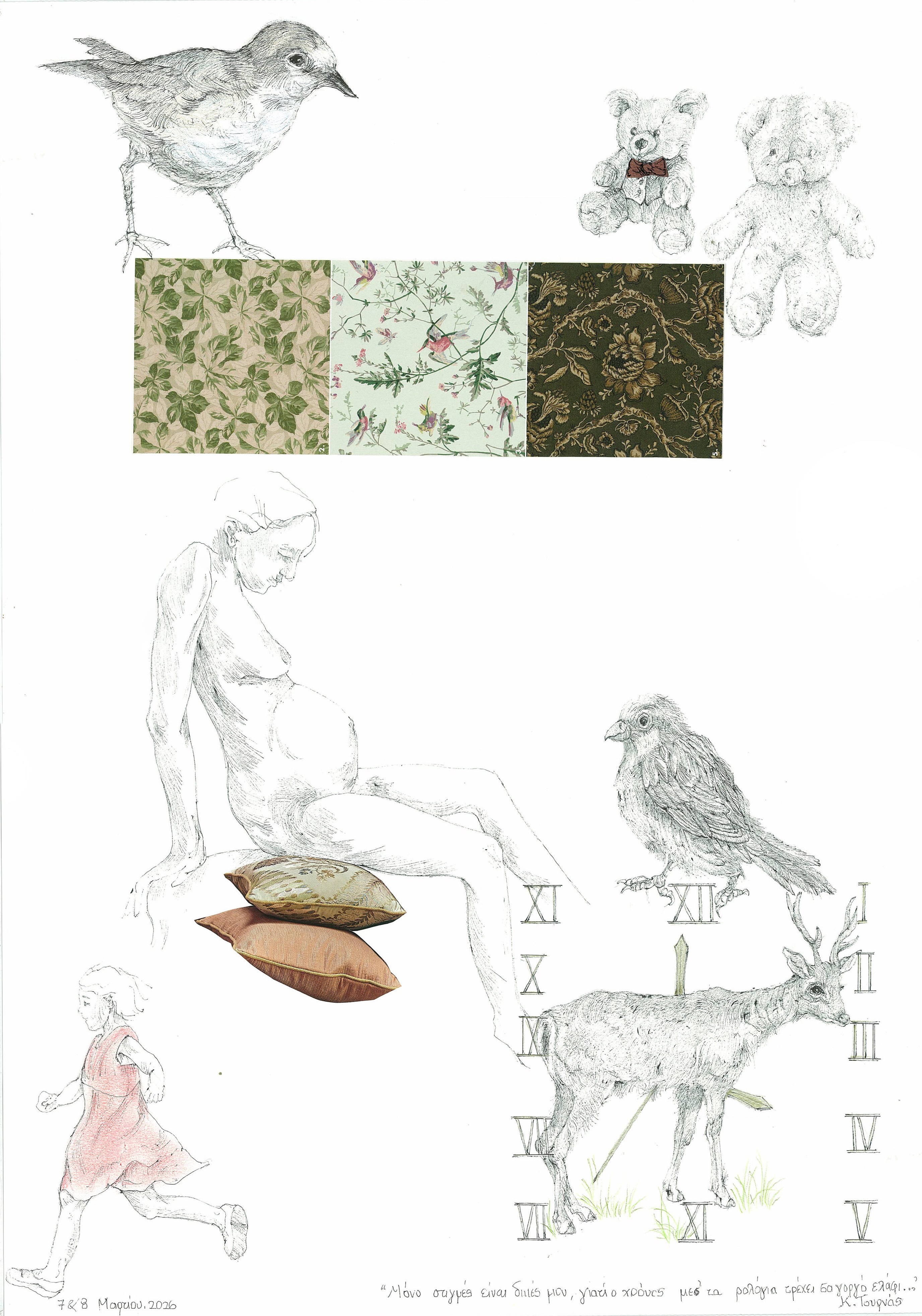
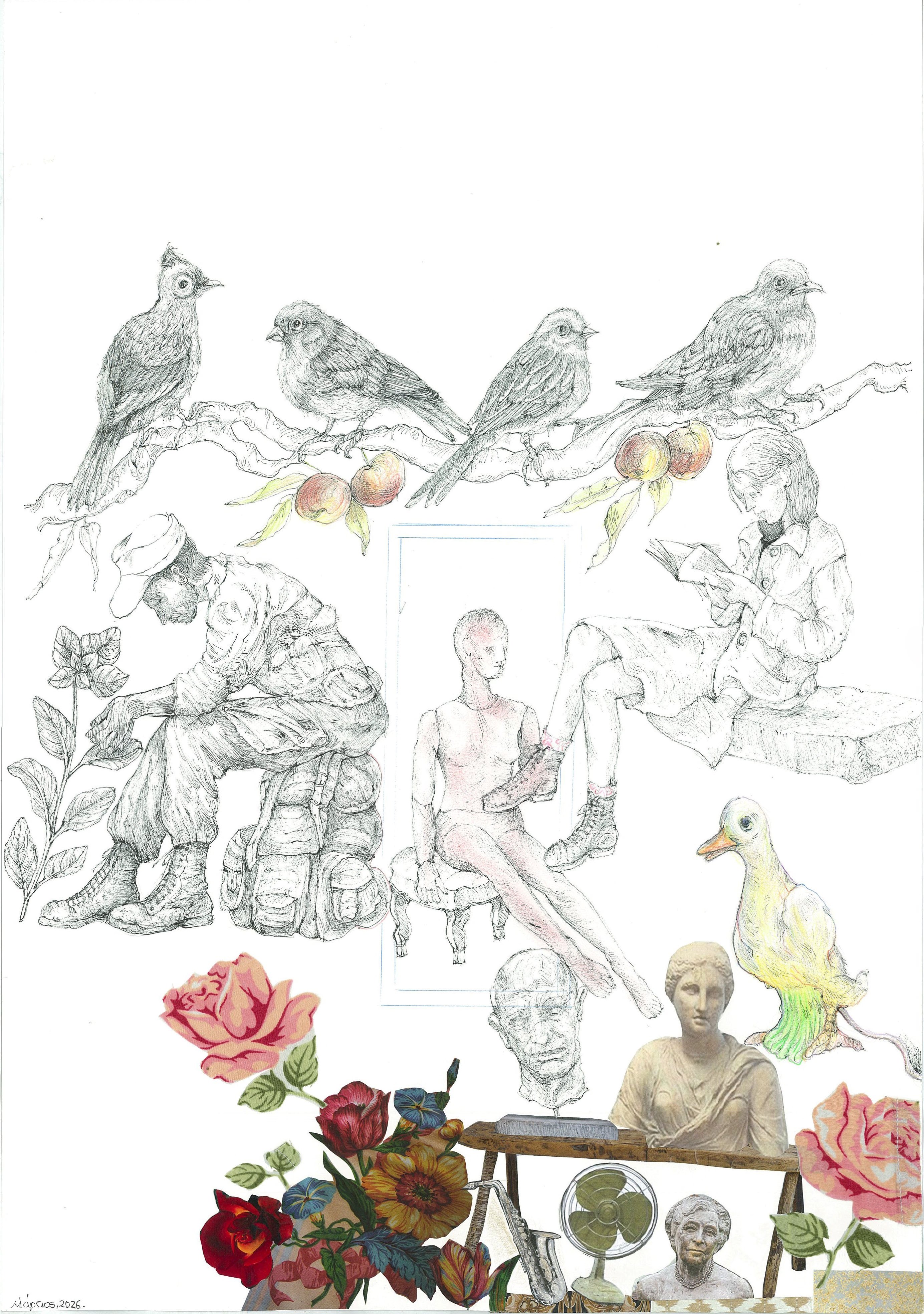
So, some of the things that I’ve read or listend to, and found of worth or interest recently, are:
Women, art, and art history
1. I re-read, feminist and art historian, Linda Nochlin’s 1971 landmark essay: Why Have There Been No Great Women Artists? (1971). In this essay, Nochlin explores the institutional, as opposed to the individual, obstacles that have prevented women from producing art and succeeding in the arts, and also, probes some of the limitations of the discipline of art history itself. The article focuses on the institutional barriers to the visual arts that women in the Western tradition have historically faced. Nochlin discusses structural constaints, and the fact that women have for centuries been excluded from academies, scholarships, and training and networking opportunities. She argues: “…… art is not a free, autonomous activity of a super-endowed individual, “influenced” by previous artists, and more vaguely and superficially, by “social forces,” but, rather, that the total situation of art making, both in terms of the development of the art maker and in the nature and quality of the work of art itself, occur in a social situation, are integral elements of this social structure, and are mediated and determined by specific and definable social institutions, be they art academies, systems of patronage, mythologies of the divine creator, artist as he-man or social outcast.”
Nochlin considers the history of women’s lack of art education and the nature of art and of artistic genius as they have historically been defined. She specifically challenges the myth of the “genius,” as an innate, male and God given talent, taking into consideration societal norms, class and institutional structures. She also argues that rather than putting emphasis only on discovering hidden women artists and female great artists (which is important), the focus should also be on revealing the structural inequalities, available discourse and societal expectations that have stifled and still stifle professional artistic commitment and hinder women from succeeding. She provides an extract from a book published in the 19th century, of advice to women that reflects the societal expectations for women, in which women were warned against “the snare of trying too hard to excel in any one thing,” social expectations that to one degree or another still prevail today across the globe:
“It must not be supposed that the writer is one who would advocate, as essential to woman, any very extraordinary degree of intellectual attainment, especially if confined to one particular branch of study………… To be able to do a great many things tolerably well, is of infinitely more value to a woman, than to be able to excell in any one. By the former, she may render herself generally useful; by the latter she may dazzle for an hour. By being apt, and tolerably well skilled in everything, she may fall into any situation in life with dignity and ease–by devoting her time to excellence in one, she may remain incapable of every other. So far as cleverness, learning, and knowledge are conducive to woman’s moral excellence, they are therefore desirable, and no further. All that would occupy her mind to the exclusion of better things, all that would involve her in the mazes of flattery and admiration, all that would tend to draw away her thoughts from others and fix them on herself, ought to be avoided as an evil to her, however brilliant or attractive it may he in itself.”
Rendering human life disposable
2.Another feminist art historian and cultural analyst’s ideas, I’ve been looking at is Griselda Pollack (b. 1949). In this particular short talk at: https://www.youtube.com/watch?v=TwMTma8raTY, Pollock refers to a talk she gave to school students on the mass genocide and dehumanization of Jews, during the Holocaust, but also more recent and current processes of dehumanizing people. She explores aspects of contemporary global society that make it possible to think and act in ways that render specific people or populations disposable. She links past historical processes and events of dehumanization and rendering human life disposable to more recent practices and students’ own experiences of practices that make others feel apart or reduce their dignity. She refers to the link between the massive, gross crimes against human life, on the one hand, and the daily erosions of everyone’s right to life and dignity, on the other hand, and the participating in current harmful processes. She then discusses “horrorism,” a form of violence against the humanity of the vulnerable or the unarmed. This, Pollock notes, is also called an ontological crime because it is a crime against the being of another. Pollock draws on feminist studies to talk about the various resources available to us to resist, one being compassion.
** In her book Horrorism Adriana Cavarero supports that we are increasingly dealing with victims who are almost all unarmed and helpless, and that violence against the helpless claims a specific vocabulary. She argues that horrorism is a radical rejection of care, a wound inflicted where care was most needed. Cavarero is interested in the perspective of the victim rather than that of the warrior, and claims that to discuss war in terms of the classical model, which has been around since antiquity, of a clash between states and soldiers that entails reciprocal, somewhat symmetrical violence, and not unilateral violence, is not precise when referring to violence inflicted upon the unarmed and defenseless. War in the 20th century and on, she claims, increasingly consists predominantly of the unilateral and sometimes planned killing of the defenseless, where the most causualties of war are helpless civilians and children by a wide majority.
Carol Gluck, professor of history and East Asian languages and culture, distinguishes between war and other obvious instances when life is rendered disposable, and structural disposability. She says, “I’m not talking about the kinds of life that is disposable in obviously clear instances like genocide, or massacre, or famine—often state-induced, or civil war even….. It’s about what I’ve come to think of as structural disposability. In other words, the people who get caught in the cracks in the system…” Henry Giroux mentioned above, has stated that “…..the number of people considered disposable has grown exponentially, and this includes low income whites, poor minorities, immigrants, the unemployed, the homeless, and a range of people who are viewed as a liability to capital and its endless predatory quest for power and profits.” Finally, Cynthia Enloe, political theorist, feminist writer, and professor, writes that when she thinks of disoposability she thinks about namelessness. She says, “When I think about disposability, I think about namelessness. ….It’s to become nameless…. So anti-disposability, then, means recovering names. But not recovering names so you can just put them on a headstone, or recovering names so you can just put them on a plaque that people may or may not pause and look at. Recovering your name means recovering your ideas. Recovering your voice….”
The birth trauma and “the primal wound”
3.Another topic I’ve been engaging with is what sometimes is referred to as “the birth wound” or “the primal wound,” which is the wounding or trauma that comes about of simply being born, for even in the most undisturbed or baby friendly birth environments the baby transitions from a state of union with the mother, and from the quiet, warm, dark womb into air, light, cold and noise. This sudden bombardment of stimuli is a stressful and violent change. It is suggested that our body remembers this first experience, which to one degree or another leaves a lasting impact on all of us. This early / primal wounding becomes more intense and leaves a deeper mark when there are birth complications, a premature or difficult labor, and other stressors very early on in life.
Philosopher, Emil Cioran, described this initial wound as a “deadly wound,” which leaves a sense of helplessness. It represents the first basic trauma of a severing of the physical bond between mother and newborn. From a psychological and developmental perspective we could say that this early wounding reflects our permeability, vulnerability and total dependency, during birth and childhood, especially our very early years. This early experience of helplessness can generate compensatory defences like the need for control, over striving, over achieving and perfectionism, particular modes of relating with others, and so on. Viewed through a psychological lens the birth and pre-verbal trauma can be processed and / or healed through good enough and appropriatively responsive caregivers, therapy during adulthood, the process of letting go of resisting and accepting our deeply rooted and inherent human vulnerability.
In 1924, Austrian psychoanalyst, writer and philosopher, Otto Rank (1884 –1939), published The Trauma of Birth, in which he proposed that the source of anxiety throughout all of life stems from the psychological trauma that one experiences during birth, which is related to Freud’s idea that birth is the first experience of anxiety, and therefore, is the source and basis of anxiety. Rank claimed that his ideas stemmed from his clinical evaluations of patients who experienced a fantasy of a second birth during psychoanalysis, and through understanding and re-experiencing the birth trauma became free from it and anxiety. Carrie Keller writes that “Rank argued that birth is the ultimate biological basis of life and that the physical experience of passing from a state of contentedness and union with the mother in the womb to an environment of harsh separation creates a trauma that causes lasting anxiety. Relating feelings experienced during birth to feelings associated with anxiety, Rank argued that birth is the source of all anxiety by drawing parallels between the feelings of confusion, constriction, and confinement experienced during birth and during other anxiety-related experiences” (2019, Embryo Project Encyclopedia, Arizona State University).
The influential British psychoanalyst, Wilfred Bion (1897 – 1979), also believed that we are “born into trauma.” He wrote “I picture myself as an infant at the very moment of birth, with an immature, sensitive brain, suddenly bombarded by the myriad and complex sensations of internal and external life. Coping would be impossible and the instinctual need to fight, escape or shut down would be overwhelming lest chaos or death become the ultimate outcome” (Carrie Keller, 2019). He believed that this early experience either remains traumatic or becomes integrated depending on the quality of the infant’s attachment to the mother, and also that attachment that leads to a sense of security and safety is a process, in which “the mother takes unarticulated and traumatizing bursts of emotional states into herself and defines them. Taken into the mother and now within the mother, the baby’s thoughts now have a historical context or basis, given to them by the mother’s ability to calmly contain, think about, and “digest” them within herself before giving them back to the infant, pre-digested, understood, named and therefore safe. In this form, the infant can have his own experiences while still believing that loving help and satisfaction in the face of pain will ease its earliest and most unbearable feeling states. The more the parent satisfies the panic of sensations that hit the newborn child, the less the “birth trauma” will haunt the infant in later life” (Carrie Keller, 2019).
Other important figures, like paediatrician and psychoanalyst, Donald Winnicott (1896-1971) explored what he termed primitive anxieties, related to failures in the “holding environment, and how birth and early infancy can be traumatic if there is a lack of a good enough environment and a good enough parent / mother. Italian child neuropsychiatrist, Alessandra Piontelli (born 1945), published a study in her book From Fetus to Child: An Observational and Psychoanalytic Study (1992). Using ultrasonic scans she examined the behaviour of 11 fetuses (three singletons and four sets of twins) and found that they reacted to stimuli in very complex ways. She then observed their development at home from birth up to the age of four years. She found remarkable behavioural and psychological continuity between prenatal and postnatal development, and her study suggested that certain prenatal experiences determined later mental life and development. Her study combines the assessment of empirical data with the observation of single case studies in the postnatal phase and in infancy, and a psychoanalytical interpretation.
The term “primal wound” has also been used to refer to the effects of separation from the birth mother on adopted children. In her book The Primal Wound, published in 1993, clinical psychologist and adoptive parent, Nancy Verrier (I’ve referred to her book in earlier posts on adoption), examines potential life-long consequences of the “primal wound,” which can potentially occur when the baby / child is separated from its birth mother.
Family systems and theory
4. In a recent Being Well podcast (March 9th // https://rickhanson.com/being-well-podcast-family-systems-theory-the-invisible-force-that-runs-your-relationships/), Forrest and Rick Hanson briefly refer to or expand on the work and ideas of influential figures, like Murray Bowen, Virginia Satir, Salvador Munichin, and others that I have written about and even included in artwork in previous posts. They discuss family systems and some of its most influential theories, theorists, concepts and family roles we are cast into or we adopt to survive early on, “written into scripts ordained even before we are born,” and how roles serve the homeostasis of a system.
They further talk about how pain and anxiety flow through family systems and through generations, how families are under pressures by broader systems, how like individuals, systems also use defenses to maintain equilibrium, how healthy differentiation can disrupt a system, and ways to become more differentiated, while balancing compassion, agency, and responsibility in order to create a more adaptive equilibrium, within the broader contexts we find ourselves in. They highlight the value of viewing ourselves and lives through a family systems lens and of recognising that we are all part of larger systems and historical and socioeconomic structures that to one degree or other determine us. They discuss the value of exploring the type of roles we were cast in, and the reasons and purpose these roles might serve. They also mention how family patterns and strategies intensify over time “until someone cracks the egg on the whole thing” and how this can lead to a blow back, the importance of refusing to be drawin in by others in order to perpetuate their script, game or status quo, and of the work required to bring about changes and to shift dynamics and patterns. Rick, I think, also refers to “the primal wound”, which I have briefly discussed above.