The humble egg……. April 11th, 2026
“There are days when I am envious of my hens: when I hunger for a purpose as perfect as a single daily egg.” Barbara Kingsolver
“If a pebble or an egg can be enjoyed for the sake of its shape only, it is one step towards a true appreciation of sculpture”. Barbara Hepworth
Today’s post is about eggs, Easter eggs and egg metaphors and imagery in mythology, art, literature, psychoanalysis and psychology.

The perfect, humble egg has served as a universal image of life, fertility and birth, the self or the person, wholeness, hope, the union of the masculine and feminine, purity, fragility, unhatched potential, transformation, mortality and rebirth, the establishment. The egg has been associated with the nest and nurturing, the mother’s womb and the sanctuary of home, and has also more recently been used by the LGBTIQ+ community. In reproductive medicine the term eggs refers to female reproductive cells / ova. Staple foods, including eggs, have always carried political weight and have been used as a metric for economic stability or inflation. Politicians use eggs to refer to the cost of living. However, eggs or rather the throwing of eggs, known as egging, which seems to have been around at least since the Middle Ages, has also been used as a form of political protest.
Easter eggs
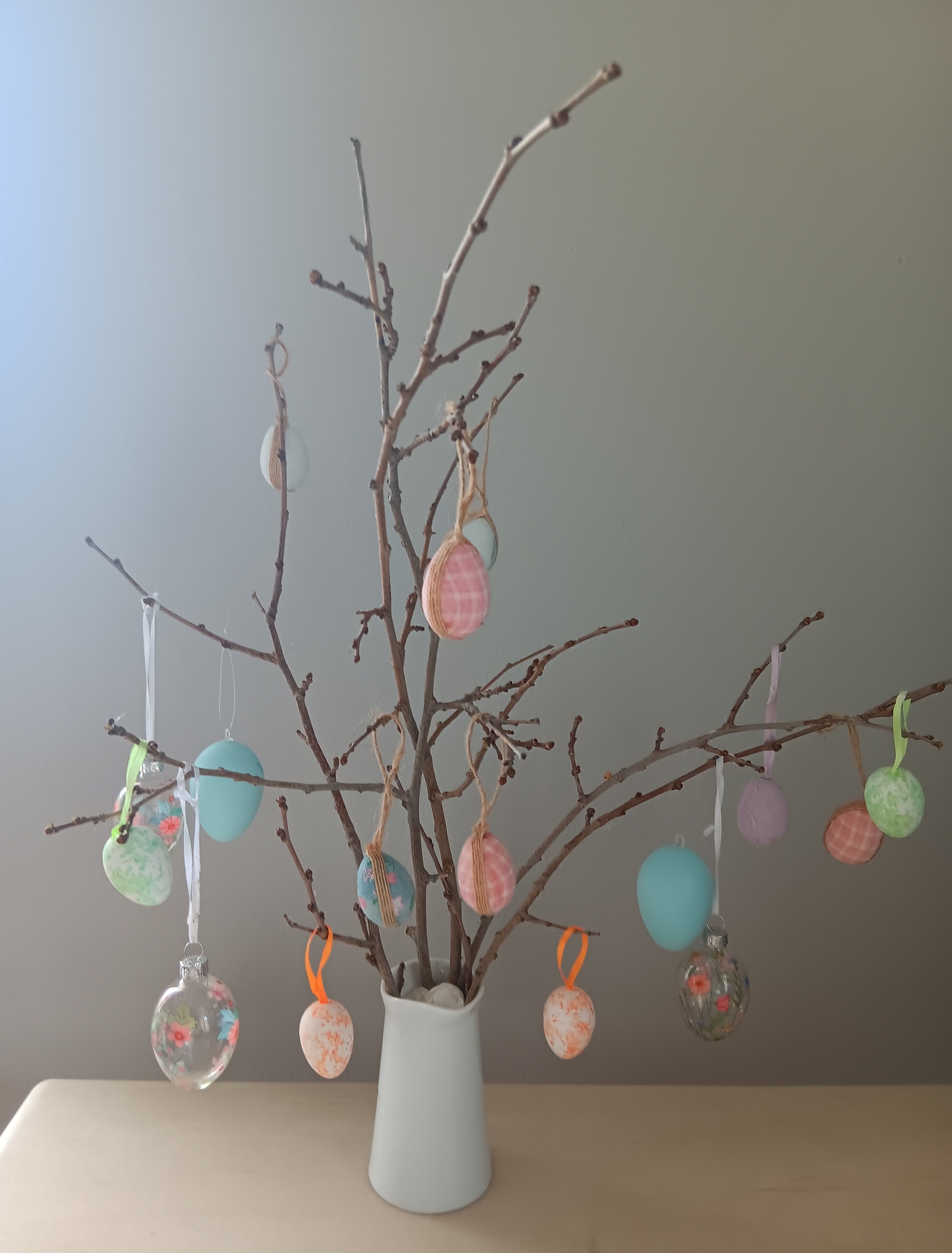
Eggs are customarily used during the Easter season in many parts of the world. I’ll begin with the Greek Easter tradition of boiling and dyeing eggs red (and other colours more recently). The red represents the blood of Jesus and the egg the sealed tomb from which he arose. During Easter meals people crack each others’ eggs and exchange Easter greetings and wishes. The last person with an intact egg is the lucky one. Egg tapping or tsougrisma / τσούγκρισμα, as we say in Greece, is practiced in many countries in Europe, and elsewhere. In South Louisiana, for instance, it is customary for the winner to eat the eggs of the losers in each round. Apart from egg tapping, there are other Easter games or activities that involve eggs. In Germany people dance among eggs trying not to step on them and it’s also customary to make Easter egg trees. Chocolate eggs (and bunnies or the threatened with extinction bilbies in Australia) are also popular, especially among children, almost worldwide now. It is believed that chocolate eggs first appeared in the court of Louis XIV in Versailles in the 18th century. In Argentina, Chile, Brazil, Uruguay and Paraguay, hollow chocolate eggs known as Ovos de Páscoa or Huevos de Páscua (Easter eggs) are popular and commonly consumed around Easter. In other countries children engage in chocolate egg hunts and egg rolling down hillsides.
It is suggested that the custom of the Easter egg can be traced back to the early Christians of Mesopotamia, and from there it spread into Eastern Europe through the Orthodox churches and later into other parts of Europe through the Catholic / Protestant churches. Sociology professor Kenneth Thompson writes about the spread of the Easter egg throughout Christendom: “…the use of eggs at Easter seems to have come from Persia into the Greek Christian Churches of Mesopotamia, thence to Russia and Siberia through the medium of Orthodox Christianity. From the Greek Church the custom was adopted by either the Roman Catholics or the Protestants and then spread through Europe.”
The practice of decorating eggs also goes back in time, and eggs engraved or decorated have been found in Egypt, Mesopotamia and Crete, where eggs were associated with rebirth, and gold or silver eggs were placed in graves in Egypt, and elsewhere.The tradition of dyeing and decorating eggs in a variety of ways (for instance, in Ukraine, and other Eastern European countries the designs on the eggs are written with beeswax) is common across most European countries, and also in many other places of the world.
Eggs in mythology
In most ancient cultures the egg is a mythological motif that represents the source of creation, holding the seed from which life sprang. It is suggested that the earliest mythological motif of eggs is the cosmic egg, which deems that the universe came into existence through the hatching of an egg. This idea was probably first documented around 1500 BC in Sanskript texts, and can be found in myths from China, Australia, Greece, and other places. In China it was believed that the cosmic egg split in two halves to give birth to Heaven and Earth. Eggs were also a symbol of celebration, and they were decorated, shared and eaten during the spring equinox, amongst the Persian Empire. In Australia the emu egg holds significant cultural importance in Aboriginal culture.
In ancient Greece the Orphic egg, named after Orpheus, a musician and poet in Greek mythology, often depicted with a serpent wound around it represented the world’s beginning. In the Orphic tradition, Phanes (Φάνης), an androgynous deity was born from the cosmic silver egg that had been created by Chronos and warmed by a serpent. In Greece figures of Dionysus holding an egg have been found, and in the Canellopoulos Museum in Athens, for instance, one can see a terracotta bust produced in a Boeotian workshop of the 4th c. BC that represents an aged Dionysus holding a kantharos (wine drinking cup) on one hand, and an egg in the other. The egg might have symbolized fertility, although it may have also been related to chthonic elements of Dionysus’ cult. In Greek philosophy the egg is used as a metaphor to represent aspects of reality. The shell represents the realm of logic, the framework for knowledge and reasoning; the egg white represents the realm of physics and the study of nature; the yolk is associated with ethics and moral principles.
Eggs in art
Eggs have also been used, sculpted or depicted by many artists across time from Pierro della Fransesca’s, Madonna of the Egg, to Hieronymous Bosch’s famous triptych painting, The Garden of Earthly Delights, where critics have suggested that the floating unhatched egg is symbol of unrealised hope or potential, and from Paul Cezanne to Andy Warhol, Victoria Hodgett’s Eggs to Breasts and Sarah Lucas’ Self Portrait with Fried Eggs, to Gabriel Orozco’s sculpture Kiss of the Egg. One artist who used the egg metaphor and image abundantly, in his paintings and architectural structures, is Salvador Dali.The extract below is from Dali’s website (https://www.salvadordali.com/art-symbolism-hidden-meanings/)
“Contrasting with the morbid symbolism of ants, eggs in Dalí’s work represent hope, love, and the promise of new life. This symbol held particular significance for the artist, who associated eggs with prenatal existence and the intrauterine universe. The egg’s duality hard shell protecting soft interior aligned perfectly with Dalí’s fascination with contrasts between strength and vulnerability. This symbolism extends to his relationship with his wife and muse, Gala, whose protective presence he often compared to an egg’s shell safeguarding precious contents within. Eggs also carry Christian symbolism, representing resurrection and spiritual rebirth. For Dalí, who maintained a complex relationship with Catholicism throughout his life, eggs served as a bridge between personal psychology and religious imagery.”
The egg metaphor in psychology and psychoanalysis
The egg metaphor in psychology is a multifaceted symbol that can represent many things. From a Jungian perspective the egg symbolizes the Self, the totality of the psychic world striving for individuation and wholeness. Within this perspective it is suggested that in dreams or symbolic work an unbroken egg may repesent latent potential, whereas, a broken egg represents change and psychological development. More generally, in therapy settings the unbroken egg represents protected potential, and the broken egg the necessary rapture that breaks the ego’s resistance and allows deeper self awareness, change and growth. It has been suggested that when an egg is broken by an inside force it represents self-motivated change rather than change forced by external forces or pressure.
In Sandplay therapy, the egg may represent the container of the unconscious mind, holding within both fear and traumatic events, and talents and potential for change and growth. In sandplay the inner world of the individual is reflected on the sand tray, as the less conscious parts of us become visible. It is similar to working with dream imagery, but unlike the dream it is three-dimensional and concrete, and also, the imagery does not fade away like in dreams, and thus, allows the person to become more aware of inner conflicts and other salient material and processes.
Within the psychoanalytic perspective, the unconscious has been referred to as a basket with eggs. In other words, the basket symbolizes the individual’s psyche that contains memories, fantasies, repressed events, and dissociated relational processes, which through techniques like free association or interpretation can be unearthed, revisited, processed and integrated. So, although the contents of our unconscious mind may be “buried” or lost to direct observation, through the “retrieving of the eggs,” parts of our experience or personality can be brought into conscious awareness for processing and integration. This process is better facilitated through the client-analyst interactions, where “buried” material or unresolved issues are co-created through enactment within the therapeutic relationship. This perspective has a more relational understanding and is somewhat different from the traditional view of the unconscious as a “basket with eggs” to be discovered and interpreted by the analyst. Here the unconscious material is a co-created, and dissociated relational processes are brought into the present moment through enactment within the therapeutic context.
Margaret Mahler (1897-1985), a psychoanalyst, who was born in Hungary and who in 1938 moved to the USA, used the the egg to describe the first two stages of a child’s development. In the Normal Autistic Phase (birth to I month) babies live as if inside their own eggshell that’s like a barrier between the baby and the outside world, and then in the the Normal Symbiotic Phase (2 to 5 months), the egg expands to include the mother, and a symbiotic union of baby and caregiver occurs, where the infant feels one with the mother / parent. Mahler used the term “hatching” to describe the emergence out of what she believed to be the self-absorption of these early phases, when the baby becomes more aware of and interested in the world around it.
Roberto Assagioli (1888-1974) was an Italian psychiatrist, polymath and pioneer in humanistic and transpersonal psychology, who founded a holistic and humanistic psychological model known as Psychosynthesis that views our inner psychic life as a struggle between conflicting forces, unified by an oragnising centre. Assagioli was imprisoned for his ideas and Jewish origins by the Mussolini regime. His ideas and approach have had an impact on psychology and psychotherapy, the human potential movement in North America in the 1960s and self help spaces. Assagioli tried to develop a multi-dimensional view of the human personality, incorporating science, psychoanalytic and existential ideas, Epictetus’ Stoicism, diverse religious and spiritual understandings and ideas of his time, astrology, and more. Some have suggested that Psychosynthesis offers a model that encompasses the conflicting disciplines of science and religion, and there are also those who believe that there are limitations to this model, and that Assagioli’s drawing from so many fields and paradigms, has resulted, one could say, in a not very well integrated theory that lacks empirical evidence.
In brief,
Assagioli created the Egg Diagram in an attempt to map the multi-dimensional nature of the human psyche and different levels of consciousness. He viewed the Egg as a house with many floors. Unlike Freud who focused more on the basement, he claimed that psychosynthesis is interested in the whole house. He believed that we tend to pay more attention to the higher levels of consciousness, and referred to the “elevator” that we build in order to access all levels of our personality. The Egg diagram includes the lower, middle and higher unconscious, the field of consciousness or conscious awareness [the part of our personality that holds what we are directly aware of at any given moment, like thoughts, emotions, sensations, impulses or desires, which we are able to observe, judge and analyse], the Self, the collective unconscious, the bridge of consciousness and the Transpersonal Self.
Basically, the lower (basic) consciousness corresponds to what is referred to in psychology as the unconscious, and represents the part of the psyche that co-ordinates autonomic processes and bodily functions. Our physical well-being, thirst, hunger, desires, instinctive drives and urges flow up from this part of consciousness and, whether we are aware of it or not, affect our behaviours and choices. This part of our consciousness is the foundation of our personality and vital for our lives, a source of our creativity and playfulness and our capacity to survive. Repressed material, early traumatic experiences or fantasies are stored here, which can all be re-activated by current events. We often experience the re-activation of this old material as anxiety, fear, anger, shame or other emotions, and inhibitions. This part is mosty without language, and the information may be experienced through imagery / symbols or sensations, and it is always active. If we are too disconnected from this aspect of ourself it can lead to psychological issues, phobias, obsessions, neuroses, psychotic breaks, etc. Unresolved issues aroud safety will leak into our behaviours and decisions, manifesting as less mature ways of being, self-sabotaging, addictions, aggression, which will require our attention. Processing and integration of this material will allow us to be more reflective and self aware.
The middle consciousness is what we might refer to as our waking consciousness, the easily retrievable memories, feelings and thoughts. It’s where most of our experience of the world takes place, and the information can easily be imagined and translated into language, and it’s here that we store our conscious self image and identity, sense of belonging, and also, challenges that stem from traumas and difficult experiences in our adolescence. Here are aspects of our consciousness related to our sense of self worth and self esteem, our relationships, the conscious or less conscious values and ideas we have about life as a result of our upbringing, education, social expectations, public discourse. It is this part of consciousness that helps us develop a path in life, and part of our desire to self-actualize and fulfill more of our potential might also reside in this field of consciousness.
According to Assagioli, the higher consciousness represents our higher aspirations and emotions like altruistic love, courage or sense of interdependence. This state might be experienced more easily when we experience ourselves as part of something greater than our individual selves, whether this is family, community, a group, society, art, religion, the universe or what Maslow termed as “peak experiences.” Our higher consciousness draws us into expressing more of who we are, and also expands our sense of self. It is this area of consciousness that allows us to experience insights and heroic aspirations for things like justice, human rights, freedom, equality, and other causes. This state of consciousness is not equivalent to Frued’s superego with its conscience, which reflects the moral laws that are culturally defined and internalised during our childhood as part of our socialization. Assagioli believed that the superego is to a certain degree introjected from parents’ commands and prohibitions, and might often be driven from fear of punishment, but the experience of higher consciousness is not connected to fear and aggression. Instead, this level of consciousness is informed by universal ethics and concerns, and a capacity to care for and be concerned about something more than ourselves or immediate loved ones. We can remain unconscious of this state of consciousness, but it is available to us through other levels of consciousness, especially, once we are relatively unburdened by survival needs.
The collective unconscious is formed by the ideas and social contexts we find ourselves in, and it’s the site of ideas, images, symbols and experiences of humanity. It is suggested that the collective unconscious represents our surrounding psychological environment through every experience and contact we have with our environement. Through, education or other means we can become aware of how we all identify with beliefs and behaviours or traits in our familial environment and broader social groups.
The personal center of identity (PCI), termed the “I” in other paradigms, is the integrated and ongoing sense of being that is distinct, but not separate from the changing aspects of our being. It’s a dynamic experience and as we integrate more aspects of ourselves we experience more of our personal centre of identity, and we can observe aspects of our experience without becoming over identified with any single experience. The Self (or the Observer), a place of “pure self awareness” in the centre of the personality surrounded by a field of consciousness, is at the centre of the Egg Diagram. Most of us are identified with the contents of our consciousness, our thoughts and feelings for instance, and we don’t distinguish between the consciousness and its contents. So, instead of saying I am angry or scared, it would perhaps be more precise or helpful to say that I am experiencing anger or fear or pain right now. It is suggested that we gain a broader perspective, our agency increases, a more stable centre of observation is established that allows us to dis-identify from contents of our consciousness, thus increasing our capacity to be present, to be more authentic and better able to process whatever is salient or bubbling up. As a result we gain more control over our experiences and decision making. In this model, the PCI could be thought of as a more fluid reflection of the full potential of the Self.
According to Assagioli, the Transpersonal Self exists above the personal “I” consciousness and is viewed as the higher spiritual core of a person. He situates the transpersonal self at the top of the egg diagram to show the direction of possible, but not inevitable expansion of personal consciousness towards an interpersonal one. He distinguishes between the lower levels of consciousness (biological drives and unresolved traumas and complexes) and the superconscious, a realm above the ordinary level of consciousness and the source, as he viewed it, of our higher human functions, behaviours and activities, our drive for meaning in life, the realm of genius and the realm of our authentic values and capacities for creation, art, scientific work, humanitarian service, or “peak experiences.”
Assagiolio’s model, ideas and interventions have been influential in the fields of psychology and psychotherapy, but some of his assumptions have been critiqued, which might be expected, since he has drawn from so many disciplines and ways of perceiving life, like science and clinical observations, psychoanalysis, humanistic and transpersonal psychology, parapsychology and astrology, unproven mystical and metaphysical assumptions, Western and Eastern religions, and Stoicism. So, although his endeavor to create a multifaceted, integrated model is viewed with positive regard, and many of his therapeutic interventions or tools for personal development and therapy are considered of value and effective, some of his claims and ideas have raised questions. Assagioli himself, was aware that his conceptualization of the human psyche (an ever changing and dynamic process) was not perfect or definitive because the Egg Diagram provided a “structural, static, almost ‘anatomical’ representation of our inner constitution, while it leaves out its dynamic aspect, which is the most important and essential one” (1975).
His ideas, for istance, of the Higher Self or the Transpersonal Self above the personal self, which exists independently of the body or brain activity, have been critiqued as having no empirical evidence, and as being ambiguous and unverified metaphysical assumptions rather than psychological facts. One could posit that as mental constructs of the mind they are useful metaphors or therapeutic tools rather than actual entities. It has also been suggested that his over focus on a higher self and higher potential can bypass trauma and other unresolved difficulties of our human condition that require attention. Some people within the psychosynthesis space have abandoned the concept of a Higher Self. Moreover, Assagioli’s claims of an “I” that is a centre of “pure consciousness”, and of an independent observer that is aware of the contents of our consciousness, while they might be useful in therapy as mental constructs, a cognitive scientific approach would argue that the self is not a static centre, but a dynamic bundle of neural processes, experiences and memories, embedded and dynamically interacting with the environment. Additionally, his conceptualization of the collective unconscious, and his suggesting that meaning, creativity, altruism and morality cannot exist on a naturalistic basis without the presupposition of a spiritual superconscious or without embarking on a spiritual journey has also been disputed.
The Trauma Egg, developed by psychologist Marilyn Murray, is a structured, visual intervention to assist in mapping and processing traumatic experiences, early attachment issues and loss. It involves drawing an oval outline on a large sheet of paper and filling it with symbolic representations (pictures and symbols instead of words) of impactful events or losses, which are separated by a curving line. It will eventually start to resemble a honeycomb. The bottom part of the egg corresponds to early memories (birth trauma, pre-school, school, and childhood more genrally).The layers above this can contain events from adolescence, young adulthood up until the present. In the space outside the egg shape we note down things about the character and personality of our parents, family rules and messages (spoken and unspoken ones), the roles we were assigned or the ones we adopted to get by, and whether the family boundaries were loose, rigid, both, and so on. After the drawing is completed an exploration begins that could include questions like: What might have you been feeling or thinking at that moment? What conclusions might have you reached about yourself, life, and other people when that happened? How did you respond / cope with it? This process assists in the uncovering of unconscious beliefs or defenses that have resulted from one’s experiences, and their impact on our choices, behaviours, and life.
The Trauma Egg diagram provides a symbolic representation of a person’s life history and major events that have shaped them. It has been described as a right brain exercise, which facilitates the surfacing of experiences through creative expression, and which allows observation and processing from some distance or place of detachment. This visual representation of significant painful experiences or losses allows one to make associations between past events and current conscious or unconscious, often disempowering, beliefs, emotions, responses and strategies, etc. It also facilitates the uncovering or revisiting of events that may be difficult to verbalize, and it allows one to take an inventory of significant traumatic events or losses throughout one’s life, which helps one discern overall patterns or dynamics, and ultimately, it enhances integrative processes.
Eggs in literature
Eggs are frequently present in children’s literature from Aesop’s fables, The Golden Eggs to Lewis Carroll’s Humpty Dumpty, who was depicted as an egg in Through the Looking-Glass, but scholars have hypothesized was not an egg, but represented particular historical events, to Dr Seuss’ stories, Horton Hatches the Egg and Green Eggs and Ham, to Charlotte’s egg sac in Charlotte’s Web story by E.B. White, and The Tale of Jemima Puddle-Duck, who seeks out a nesting place in the forest because she’s not allowed to keep the eggs she lays at the farm, and puts herself in danger, written and illustrated by Beatrix Potters, to mention those that quickly sprang to my mind.
However, egg metaphors and symbolism are abundant in adult literature and poetry, as well.
Some samples:
The egg of forests by Emily Dickinson
“…. To invest existence with a stately air, // Needs but to remember
That the acorn there // Is the egg of forests……”
The Egg, a moving, short story, was written by Czech Jewish writer, Ludvík Aškenazy (1921-1986) and made into a film in 1964. In brief, a young student from Prague, loves making prank phone calls; especially, to a gentleman with a funny name that means rooster, whom he gets into the habit of phoning every Friday after school. Mr. Kohoutka never raises his voice or tells him off for his rude or annoying questions. He always listens to the boy and responds politely. The years go by, the boy grows up, he goes to university and then the war happens. Six years later when he returns to Prague, alone and uncertain of what to do next, he calls Mr. Kohoutka.
The Egg is also the title of an allegorical one-act play from the satirical TV series, He and He [Lucas and Solon are two elderly men who live on the streets] by Greek writer, Kostas Mourselas, where realism co-exists with humor and subversive thinking, and which functioned as a mirror of societal realities of that era. The egg, here, symbolizes the establishment, which is a closed off world that allows those who enter it to realize their ambitions, gain financial rewards and a comfortable life, acquire power, but at the price of loneliness, isolation and the loss of freedom.
Japanese writer, Haruki Murakami (2009):
“The high wall is the system which forces us to do the things we would not ordinarily see fit to do as individuals…. We are all human beings, individuals, fragile eggs. We have no hope against the wall: it’s too high, too dark, too cold. To fight the wall, we must join our souls together for warmth, strength…..”