War and Children
“….. Children should never be caught in the crossfire, and their homes, schools and communities must not become battlefields. Wars have laws. Children and schools must be off limits.” Inger Ashing (CEO of Save the Children International)
“….development demands its own conditions, irrespective of war and peace or all other happenings in the outer world.” From War and Children by Anna Freud & Dorothy T.Burlingham
As I mentioned in the previous post today’s piece is about Anna Freud and Dorothy Burlingham’s book, War and Children, which is based on their case-history notes drawn from daily contact with a living, war-time laboratory, and their reports that show how they reached their conclusions. Freud and Burlingham’s work is based on the fundamental idea that the care and education of young children should not take second place in wartime, nor should it be reduced to wartime level. They claim that like the lack of essential foods in early childhood will cause lasting bodily malformation in later years, even if the harmful consequences are not immediately apparent, the same is true for the mental development of the child, and whenever essential needs like the need for personal attachment, for emotional stability, and for permanency of educational influence are not fulfilled,“lasting psychological malformations will be the consequence.”
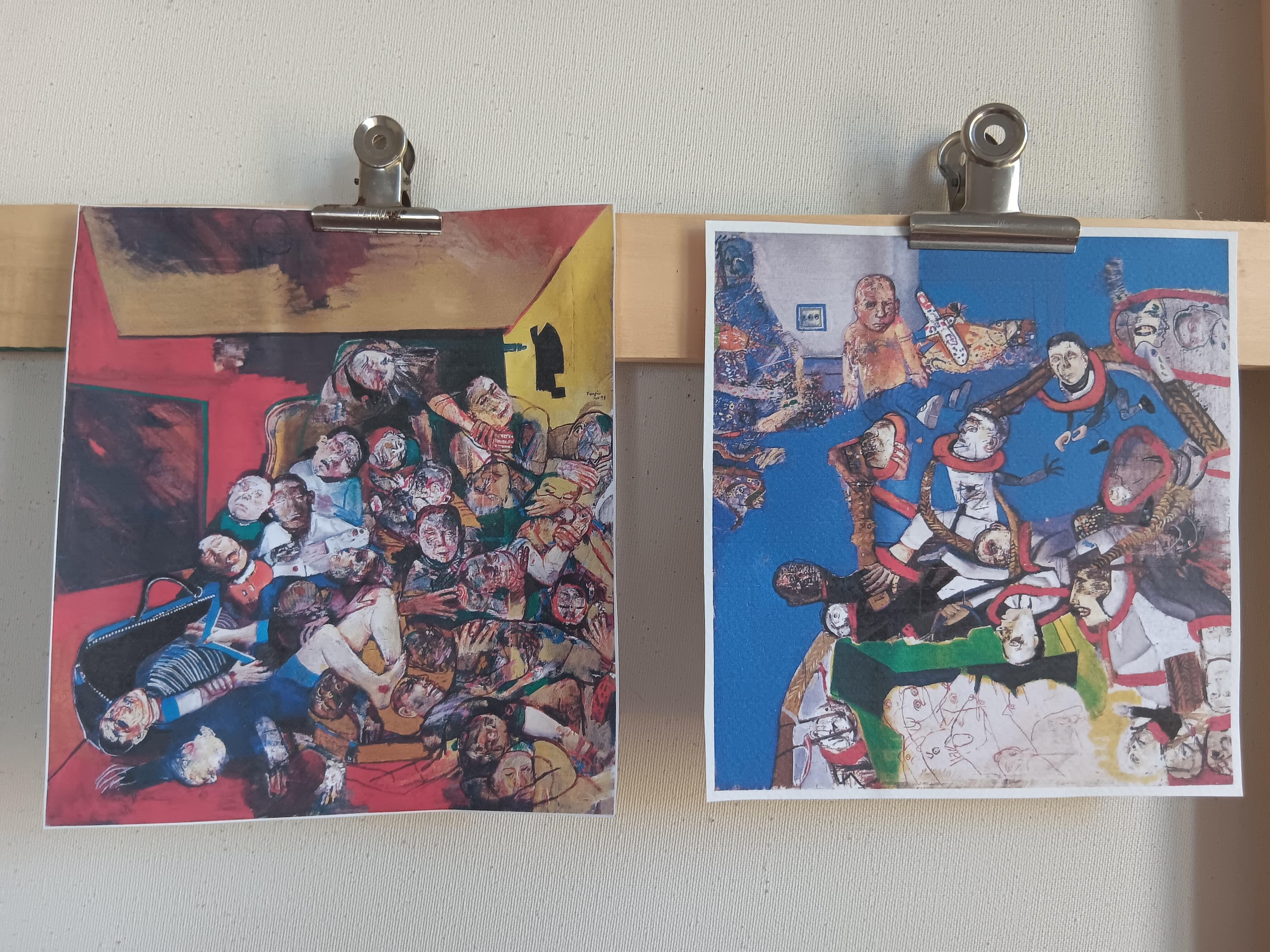
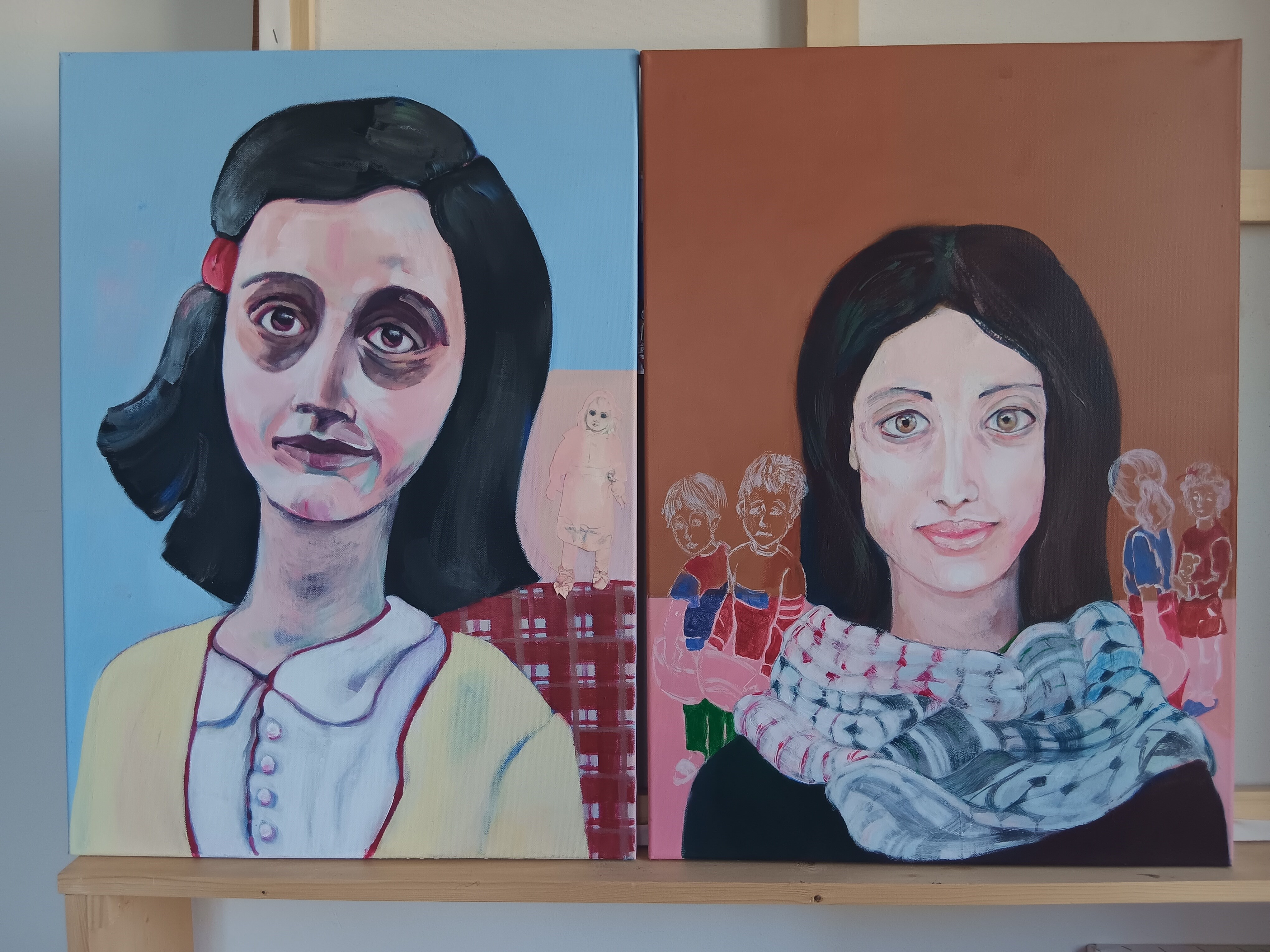
I have accompanied the text with two works by a favourite painter, Eduardos Sakayan, Child and Castaways (1994-1998) and Human Heap or Waiting List (1990-1998), which do not depict scenes of war, but came to my mind as I was wondering what images to choose to accompany today’s text, maybe because I had the pleasure of seeing some of his paintings, along with other artists’ work, at the municipal gallery, and two of my own older images from a mosaic of figures.
Even though this material was written in the 1940s, and despite the more recent findings and knowledge around child development and attachment in the fields of psychology and medicine, Freud and Burlingham’s work is inspiring and their observations and findings remain valuable and important. The book is also a reminder of our humanity and our duty towards the young. Additionally, I feel that this material is highly relevant today, as we have been witnessing conflict and wars around the globe, where civilians have been increasingly targeted, homes, hospitals, schools and desalination plants bombed, and large numbers of children are witnessing destruction, are being killed, amputated, starved, and orphaned.
In 1941, pioneering child psychoanalyst, Anna Freud, and Dorothy Burlingham established three wartime childrens’ homes in response to the air raids on London, for all those children who had lost parents or homes, or those whose mothers had fallen ill or had to bring them to air raid shelthers every night. Freud and Burlingham observed that the break down of families impacted the children more than the actual war experiences, and unlike other homes for children, the Hampstead War Nurseries, placed emphasis on maintaining regular visits from mothers, and other family members when possible, and also on fostering sibling bonds. Along with the care and education of the children, psychoanalytic work and developmental observations, also took place, and these findings were published at the time and are included in this book.
Freud and Burlingham’s goal was to work towards certain main achievements:
to repair the damage already caused by war conditions to the bodily and mental health of children and to prevent further harm being done to the children. Therefore, when babies had to be separated from their mothers efforts were made to keep them in comparative safety within easy reach of their families; to facilitate visiting so that the baby could develop an attachment for and knowledge of its mother and be prepared for a later return to family life, and for older children the necessary provisions were made for ordinary peace-time education, while again trying to preserve the remnants of family attachments as much as possible. Another achievement they strived towards was to do research on the essential psychological needs of children, study their reactions to bombing, destruction and early separation from their families, collect facts about the harmful consequences whenever their essential needs remained unsatisfied, observe the influence of community life at an early age on their development, and finally, to instruct people that were interested in forms of education based on psychological knowledge of the child, and to work out a pattern of nursery life which could serve as a model for peace-time education.
Many interrelated topics are discussed in the book accompanied by study case examples. Inevitably I will briefly touch upon a few. I also need to say that Freud and Burlingham’s conclusions are the result of their observations and work with children, as well as, their psychoanalytical background.
In relation to matters around separation they conclude that the fact that evacuation under the present conditions is as upsetting as bombing itself, is no proof that better methods of evacuation could not be found, which guard the children’s life and bodily health, while at the same time provide the possibility for normal psychological development and steady progress in education. They assert that if separation between the child and the mother happened slowly, and if the people who are meant to substitute for the mother were known to the child beforehand, then transition from one object to the other would proceed gradually. And if additionally the mother reappeared several times during the period when the child had to be weaned from her, although the pain of separation would be repeated, it would be felt in smaller doses each successive time, allowing the child to process and adapt because there would be “no empty period in which the feelings of the child are turned completely inward and, consequently, there would be little loss of developmental achievement because regression occurs when the child is passing through the no-man’s-land of affection, i.e. during the time the old object (person) has been given up and before the new one has been found,” which can do incalculable harm to a child’s normal development. Two poignant examples of the children under their care that had expressed this state of mind in their own words reveal to us the pain and confusion felt by the child. One little boy almost four years old had said: “I don’t like you, I don’t like anybody! I only like myself,” and another five year old boy had exclaimed: “I am nobody’s nothing.”
As I mentioned above Freud and Burlingham observed that although long drawn-out separation may bring more visible pain, it is less harmful because “it gives the child time to accompany the events with his reactions, to work through his own feelings over and over again, to find outward expressions for his state of mind, i.e. to abreact slowly.” They believe that it is important for evacuation to occur in slow stages, to offer mothers who refuse to part from their young children the chance to work as paid domestic staff, to maintain the remnants of the parent relationship, as far as possible, prepare the children for their return to their homes after the war, and also, have little or no restriction of visiting rules. They also add that if babies have to be separated from their mothers, it is best they go to crèches near factories, for instance, where their mothers can leave them in the morning and collect them after work.
They explore the mother-child relationship in the early stages, and how devastating sudden separation can be resulting in long drawn-out states of homesickness, upset and despair, which are certainly more than the average inexperienced foster mother can be expected to cope with. Additionally, separation and lack of visits is understood by children as rewards and punishments. One example that demonstrates the more severe effects of this separation is Beryl, a four year old “who sat for several days on the exact spot where her mother had left her, would not speak, eat or play, and had to be moved around like an automaton.” Freud and Burlingham describe how they had little girls of three and four who would “hang around” the doors for hours on end when their mothers were expected to come, but then during the visits they would be gloomy, shy, and hang onto them without talking. Then when their mothers had left the affection broke through and violent emotional scenes took place.
They discuss how difficult it is to wean the very young child away from its mother, and how it’s just as difficult to try and keep alive in the child remnants of its original relationship to the mother, and parents more generally, because unfortunately children under three will forget about their parents or at least become apparently indifferent towards them. Freud and Birlingham tell us that after three years of age children will not normally forget their parents, and their memories tend to be more stable, since it is easier for them to find active and conscious expression for their feelings, the image of the parents remains in their mind, especially when helped from the outside by frequent visits, gift parcels, and constant talk about the parents. It is natural in the phantasy life of the child for the absent parents to seem better, bigger, kinder, and the natural negative feelings that children also have about their parents to undergo repression; however, this repression creates a variety of mood and behavioural problems. But eventually, because children live mostly in the present and because new bonds are inevitably formed in their new environment, these children too move their affection towards the parental substitutes. This creates all sorts of problems when it is time for the child to return home, especially, for the younger ones, because the children’s home has become home for them, and of course, it is painful and stressful for parents.
Another topic they discuss is anxiety and the more common types of air raid anxiety. They begin by explaining that children need to be safeguarded against the primitive horrors of the war, not so much because horrors and aggression are completely strange to them, but because during these early and decisive stages of their development it is important for them to overcome and estrange themselves from the primitive aggressive wishes of their own infantile nature. They explain how after the first years of life the child gradually learns to refuse to give conscious expression to certain aggressive instinctive wishes. The child learns that it is bad to kill, to hurt and to destroy, but can only keep up this attitude when the people in the outer world do likewise. Freud and Burlingham say that when children see killing and destruction going on outside it arouses their fear that the impulses which they have only a short while ago buried will be awakened again, and this they add, explains why younger children in whom these inhibitions against aggression have not yet been established is free of the abhorrence of air raids. However, slightly older children that have just been through this developmental process can be particularly sensitive to the menace of air raids, and can have real outbreaks of anxiety when bombs come down and do damage around them.
One other reason for the development of fear reactions is also the fact that a child is afraid naturally and sensibly when there is some real danger in the outside world that threatens either their safety or existence. The fear will be all the greater the more the child knows about the seriousness of the danger, and the fear will urge him / her to either fight it or if that is impossible, try to escape from it, and if the danger is overwhelming then the child will be shocked and paralysed into inaction. They also clarify that knowledge and reason only play a limited part in a child’s life. Its interest quickly turns away from the real things in the outer world, especially when these things are scary or unpleasant, Children deny the facts, get rid of their fear, and revert back to their childish interests, toys, games and phantasies.
They also refer to a third type of anxiety, which develops a little later into a fear of the child’s own conscience, and this is the fear of authority and prohibitions, when the child more or less has learnt what to do and what not to do “under the direction of a nucleus of inner ideas, which is his own conscience”. They claim that the child “turns back continually to the figures of the outside world, on the one hand, and to the imaginations of his/her own phantasy on the other, and borrows strength from both to reinforce the inner commandments.” It is the stage when children are afraid of ghosts and bogeymen, sometimes used as reinforcements of the real parental figures and of the inner voice. Freud and Burlingham add that children have a large list of dangers which serve as convenient symbols for their conscience, they can be afraid of policemen, gypsies, robbers, and other figures, real or fictional, dragons, lions and tigers, earthquakes and thunder and lightning. When they receive religious teaching they are afraid of the devil and of hell or that God will know what they’re thinking or when they’ve been naughty, and as a result punish them, while those who receive no religious teaching will transfer the same fear to other things like the moon, and so on. Children often also fear the end of the world, abandonment and the death of their parents. Therefore, Freud and Burlingham note, air raids, sirens and bombs, are simply new symbols for old fears, and Hitler and German planes take the place of the devil or wild animals. Finally, children do not only develop the fears which belong to their own age and stage of development, but that they also internalize the fear reactions of their mothers, and of the grown-up world around them.
Another theme included in the book is how children deal with shocks, deprivations, and upsets in their outside life, since psychological methods which are open to adults are not yet available in childhood, One outlet, for instance, when something disruptive or traumatic happens is that of speech, which is not an option for the younger children, and while adults can go over their experiences in conscious thought and speech, young children cannot. For children there’s the outlet of play and they can process things in their play. Children like adults can also find an outlet to what’s traumatic or painful or unwanted in behaviour. Freud and Burlington write, “Some children are unable to express what has happened to them either in speech or in play. Instead, they develop behaviour which seems cranky to the outside world until it can be recognised.” They can also find an outlet in phantasy. Children largely use conscious phantasies to embellish and maintain the positive side of the child-parent relationship. Children can also regress, in other words, return to infantile modes of behaviour because, as Freud and Burlington say, every step in early education is closely connected with one of the phases of the child’s attachment to someone in the outer world. Bed wetting can also occur because it takes time before bladder and sphincter control becomes purely automatic, and “a small child will normally have a setback in its habits when it changes hands,” and this can often be one of the expressions of a breakdown of their relationships with their mother or primal caregivers.
Freud and Burlingham also discuss responses of gratification that children can regress to or over indulge in as mechanisms of soothing. Demands for affection can be transformed into a demand for food or material presents, which can be used as a symbol for the mother, which means that the child has regressed to the stage when the value of the mother was still measured in terms of the material comfort derived from her person. Denial and regression can also lead to greed for food or sweets. As for aggression, they say, during these violent times, children at the nursery stage can become more aggressive and destructive than they were found to be in normal times, and due to the loosening of early repression and inhibition of aggression, as a result of what they experience and see in the outside world, it is easy for the child to return to earlier developmental modes of expression. They mention that a frequent occurrence in all the residential war nurseries was older children’s temper tantrums.
Another response displayed by children was abnormal emotional withdrawal or emotional outbreaks. They provide examples of children who had moved around a lot and how disruptive this was for them in different ways. For instance, they describe how a young boy, whose mother was in hospital with tuberculosis and who had been placed in a variety of contexts, seemed completely devoid of all emotion. He stayed where he was put and did not seem afraid of the new surroundings, made no distinction between one grown-up and another, clung to no one and avoided no one, ate, slept and played and was no trouble to anybody. This ice was broken only when he fell ill and was isolated with one nurse, who put her arm around him to keep the themometre in place, which aroused in him memories of being in his mother’s arms. A girl, on the other hand, who had been placed in six different unsuitable places between the age of two and three, failed to recognise her rmother though both parents visited in turns fortnightly. She had emotional outbreaks of a hysterical type and displayed phobic and compulsive behaviours, would not go to bed, could not sleep, would not eat, fought against being bathed, washed, dressed or undressed, told phantastic tales of negative events, and had lost interest in the real world. Also, children that had been moved around a lot or whose placements had gone wrong, sometimes engaged in a continual abandoning of people they were attached for the sake of others who were new. One girl, for instance, having lost her stable relationship to her parents lived continually in search of new people to attach to. Freud and Burlingham write that they recognised this symptom of flight from one object to the other in adults as one of the results of early disturbances of their mother or early caregiver relationship.
The second part of the book includes reports from January 1941 till December 1942, which give us an opportunity to follow the events as they occurred and see how Freud and Burlingham reached their conclusions. This part of the book contains many short vignettes, which allow us to catch a glimpse of what was going on in the children’s hearts and minds, and also, what it was like for the mothers, diverse as they were, who were forced through the war circumstance to separate from their children sometimes as young as a few weeks old. This is the more moving part of the book and at times I found tears welling up as I read it, and it also made me wonder how these war children coped with all this experience as they got older and how all this impacted their lives in adulthood.
In this part they also describe parents’ responses, working class parents in particular, how the home took on the character of a coffee house, club or restaurant during weekends as parents were encouraged to visit freely, spend time with their children, eat meals with them, and take them for walks. They also provide examples of how different children reacted to air raids and of how separation can impact children differently depending on many factors, and also, on how evacuation is done. A three year old boy, who had been separated from his mother several times due to her being sick, on trying to keep his promise to his mom to be “a good boy and not cry” tied himself into a knot. Freud and Birlingham write, “We were shocked to see an apparently healthy child develop a compulsive tie under our very eyes.” While the other children were mostly busy with their toys, playing games, making music, eating, Patrick engaged in one compulsive behaviour after another, all the while trying to be brave. Fortunately, his mother recovered and she took the paid post of emergency night nurse, which meant that she spent five nights weekly in the same house with Patrick, which in turn allowed Patrick to evolve into “one of the most active children in the playroom.”
Examples of how children act out things in play are also included. For instance, the day after the big air attack on London on the 16th of April, several children had climbed up on the jungle gym, and were preparing to drop a heavy iron object they had found in the garden, proudly asserting that it was a bomb. Another example of how play reflects experiences and also helps children process them was their request to turn an empty bookshelf into a dolls’ shelter. There’s also reference to processes of identification, where in, one instance, a little girl possibly developed a consistent cough in imitation of her father’s cough after he died.
The creation of artificial orphans, which is one of the most serious objections to war time evacuation of young children without their mothers, is also explored. For the young children the bodily absence or presence of the mother is significant because the emotional needs of the child cannot be satisfied from a distance, and the love of the infant for its mother is closely bound up with the fulfilment of these needs, and when the mother is absent, the child forms, “after a short period of longing, a new relationship to a substitute mother.” Freud and Burlingham point out that although all these children who are separated from their parents are also war orphans the attitude of the world is to disregard this expecting the evacuated children to “fret and get over it in ‘no time’”. They conclude that it is “precisely the study of the real war orphan and his reactions, which may be of help to create a better understanding of the evacuated child”.
Many other topics are also explored like their decision to create artificial families and assign children to substitute mothers because they had noticed that certain steps in development were slow in coming in spite of all the opportunities provided, and children were reluctant to grow out of their baby habits. This decision, they soon observed, brought about astonishing results. They also discuss the inner ambivalent attitudes of the mothers, pointing out that they had observed that although a lot had been said about the foster mothers, not much attention had been paid to the biological mothers and how they felt and dealt with the separations and the predicament they found themselves in, on the one hand, wanting to keep their children safe, better fed and educated, and on the other hand, their natural inclination and desire to keep their children close to them, and their fear of the effects of separation. They also discuss the experience of a smaller group of mothers, who were less “motherly” or more ambivalent in regrads to their children, and also, mothers in difficult circumstances with “illegitimate” babies, for whom the nursey provided an outlet, and sometimes also helped them to work out their conflicting feelings and attach to their babies.
In one of the final chapters Freud and Burlingham reveal to us through short vignettes the children’s meaning making of the war, and what questions they raised and what conclusions they reached. One child concluded that the Germans bombed them because they had been noisy. Another commented that the German pilot was kind because he didn’t drop it on their home, and another when told that the German pilot was caught was not relieved, but worried about his fate and said that he would not like to see a dead man. The children also understood the war as a conflict between God and Hitler, good and evil. They wondered why God made the Germans nasty, who he would help win the war, and one child asserted that God would help both because he loves all people.
I will end this piece today with an extract from the article: War Children: Victims, Threats and Promises of the Future [Enfants de la guerre. Victimes, menaces et promesses d’avenir] by Stefania Bernini
“Against the evacuation approach, adopted by the British government since the beginning of the conflict, Freud and Burlingham argued that the war had its worst impact on children when it broke down family life and uprooted “the first emotional attachments of the child within the family group”. The paradoxical conclusion was that “London children […] were on the whole much less upset by bombing than by evacuation to the country as a protection against it” (Freud, Burlingham 1947: 171-73; Bowlby, Winnicott, Miller 1939: 1202-1203). Separation from the mother was the event most likely to produce lasting damages in children (Howarth 1941, Odlum 1941). The age of the child and the way the evacuation was organized, argued Freud and Burlingham, were crucial in determining the likely outcomes. On the whole, the analysis carried out in the Hampstead Nurseries, like those conducted among evacuated children by Susan Isaacs in 1941, put forward a stark picture of the impact of war on British children and cast a shadow on what would happen in its aftermath (Isaacs 1941).5 By turning their attention to children’s deepest and often hidden reactions to war, Freud and Burlingham suggested that even an apparently undamaged child could harbour the seed of later psychological and emotional sufferance. They gave voice to a fear that would remain at the core of post war reconstruction” (https://journals.openedition.org/revss/5812?lang=en).