
Warm wishes

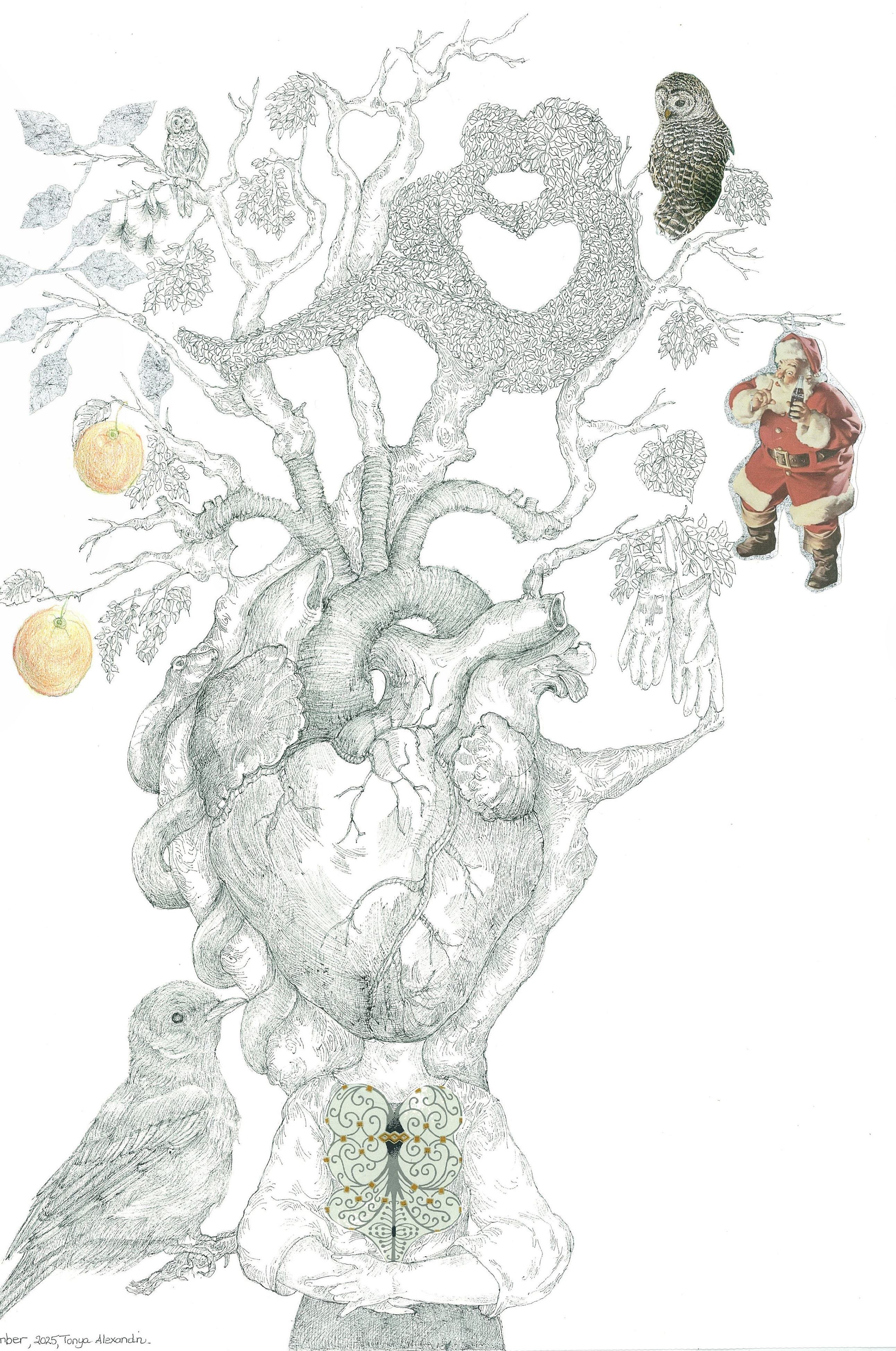
Today’s post is about the history of kindness, and even more specifically, it concerns two books that I’ve been reading over the last few weeks: On Kindness, a treatise by Adam Phillips and Barbara Taylor [psychoananlyst and historian respectively], and a much longer book Humankind: A Hopeful History by Rutger Bregman [historian]. I’ve also included three recent pieces of artwork.
 In brief,
Rutger Bregman engages in a multidisciplinary study of historical events, of scientific studies, especially, in the area of social psychology, and philosophical argumentation, and he draws on economics, psychology, biology, anthropology and archeological findings. He also expands on the old and always salient nature debate between Jean Jacques Rousseau and Thomas Hobbes, and argues that humans are fundamentally decent and that ignoring this fact does not benefit humanity, as holding negative expectations of people leads to more people embracing cynicism. Bregman offers a different perspective, turning to different sources, in order to unchain us from a dogmatically cynical, and to some extent distorted views of human nature. He deconstructs bad scientific studies, unethical experiments (Zimbardo, Milgram, Muzafer Sherif, etc) and misinterpreted findings, biased or sensational reportage, and misrepresented historical events. The book certainly makes us reflect on what we take for granted and how much information we absorb unquestioningly, and it makes us question things, which one can assume was the writer’s intention. Overall, his book is a powerful argument for innate human decency and human virtue.
 In their essays, On Kindness, Adam Phillips and Barbara Taylor present an analysis of kindness in history, in life and the contemporary world. They ask why our faith in kindness has been shaken and why we are so easily convinced that antagonism has replaced it, why kindness feels threatening, and why despite our longing for it we deny the pleasure of kindness and are weary of receiving it. Philips and Taylor discuss how kindness is the foundation of the world’s great religions and philosophies and they examine the pleasures and perils of kindness. Drawing on history, literature, philosophy, psychoanalysis, and contemporary social theory, they explore why we have been taught to perceive ourselves as fundamentally antagonistic and bad, and how and why we have chosen loneliness over connection. They argue that a life lived in instinctive, sympathetic identification with others is the one we long for and should allow ourselves to live.
Hopefully, I will write more about the books and kindness in the next post. Meanwhile, I will include two extracts from their books.
In the fisrt part of his book Rutger Bregman writes:
“This is a book about a radical idea. An idea that’s long been known to make rulers nervous. An idea denied by religions and ideologies, ignored by the news media and erased from the annals of world history. At the same time, it’s an idea that’s legitimised by virtually every branch of science. One that’s corroborated by evolution and confirmed by everyday life. An idea so intrinsic to human nature that it goes unnoticed and gets overlooked. If only we had the courage to take it more seriously, it’s an idea that might just start a revolution. Turn society on its head. Because once you grasp what it really means, it’s nothing less than a mind-bending drug that ensures you’ll never look at the world the same again So what is this radical idea? That most people, deep down, are pretty decent………..
I want to share three warnings. First, to stand up for human goodness is to stand up against a hydra – that mythological seven-headed monster that grew back two heads for every one Hercules lopped off. Cynicism works a lot like that. For every misanthropic argument you deflate, two more will pop up in its place. Veneer theory is a zombie that just keeps coming back. Second, to stand up for human goodness is to take a stand against the powers that be. For the powerful, a hopeful view of human nature is downright threatening. Subversive. Seditious. It implies that we’re not selfish beasts that need to be reined in, restrained and regulated. It implies that we need a different kind of leadership. A company with intrinsically motivated employees has no need of managers; a democracy with engaged citizens has no need of career politicians. Third, to stand up for human goodness means weathering a storm of ridicule. You’ll be called naive. Obtuse…….. Basically, it’s easier to be a cynic.”
On Kindness by Adam Phillips and Barbara Taylor
“Kindness, one could say, complicates one’s relations with others in peculiarly subtle and satisfying ways; and for a very simple reason. Acts of kindness demonstrate, in the clearest possible way, that we are vulnerable and dependent animals who have no better resource than each other. If kindness previously had to be legitimized by a God or gods, or located in women and children, it is because it has had to be delegated; and it has had to be delegated and sanctioned, and sacralized, and idealized, and sentimentalized because it comes from the part of ourselves that we are most disturbed by, the part that knows how much assurance and (genuine) reassurance is required to sustain our sense of viability. Our resistance to kindness is our resistance to encountering what kindness meets in us, and what we meet in other people by being kind to them. And, of course, our resistance to seeing the limits of what kindness can do for us…..
So the pleasures of kindness advocated in this book could never be the pleasures of moral superiority, or domineering beneficence, or the protection racket of good feelings. Nor are acts of kindness to be seen as acts of will, or effort, or moral resolution. Kindness comes from what Freud called – in a different context – ‘after – education, that is, a revived awareness of something that is already felt and known.’ And this after-education, of which this book perhaps is a part, entails the recognition of kindness as a continual temptation in everyday life that we resist. Not a temptation to sacrifice ourselves, but to include ourselves with others. Not a temptation to renounce or ignore the aggressive aspects of ourselves, but to see kindness as being in solidarity with human need, and with the very paradoxical sense of powerlessness and power that human need induces. Acts of kindness involve us in different kinds of conversations; our resistance to these conversations suggests that we may be more interested in them, may in fact want much more from them, than we let ourselves know.”