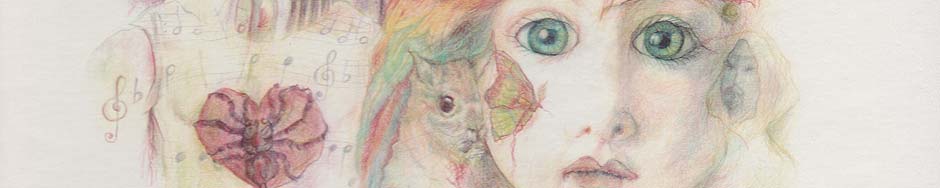
“Indeed, he [Alex] had given us a glimpse of another world, one that had always existed but remained beyond our view: the world of animal minds.” Irene Pepperberg
“A rich social context is essential to teaching communication and communication skills….” Irene Pepperberg
Today’s post is about the advanced cognitive and emotional capacities of Alex, the African Grey parrot, who got his name from “Project ALEX: Avian Language EXperiment.” More specifically, I’ll be referring to Irene M. Pepperberg’s work and book, Alex & Me: How a Scientist and a Parrot Discovered a Hidden World of Animal Intelligence—and Formed a Deep Bond in the Process. Irene Pepperberg, born in 1949, has a Ph.D. in Chemical Physics from Harvard University and is currently an Adjunct Research Professor at Boston University. In the past she has conducted research or taught in universities, susch as, Harvard University, Brandeis University, Radcliffe Institute, the MIT Media Lab, the University of Arizona, Purdue, and more. Her work includes both studying the mechanisms of parrots’ learning as well as the outcomes, has received honors and awards, has been featured in newspapers, magazines and on television in the USA, Europe, and Asia, and after Alex’s death there was an outpouring of public recognition across the globe.
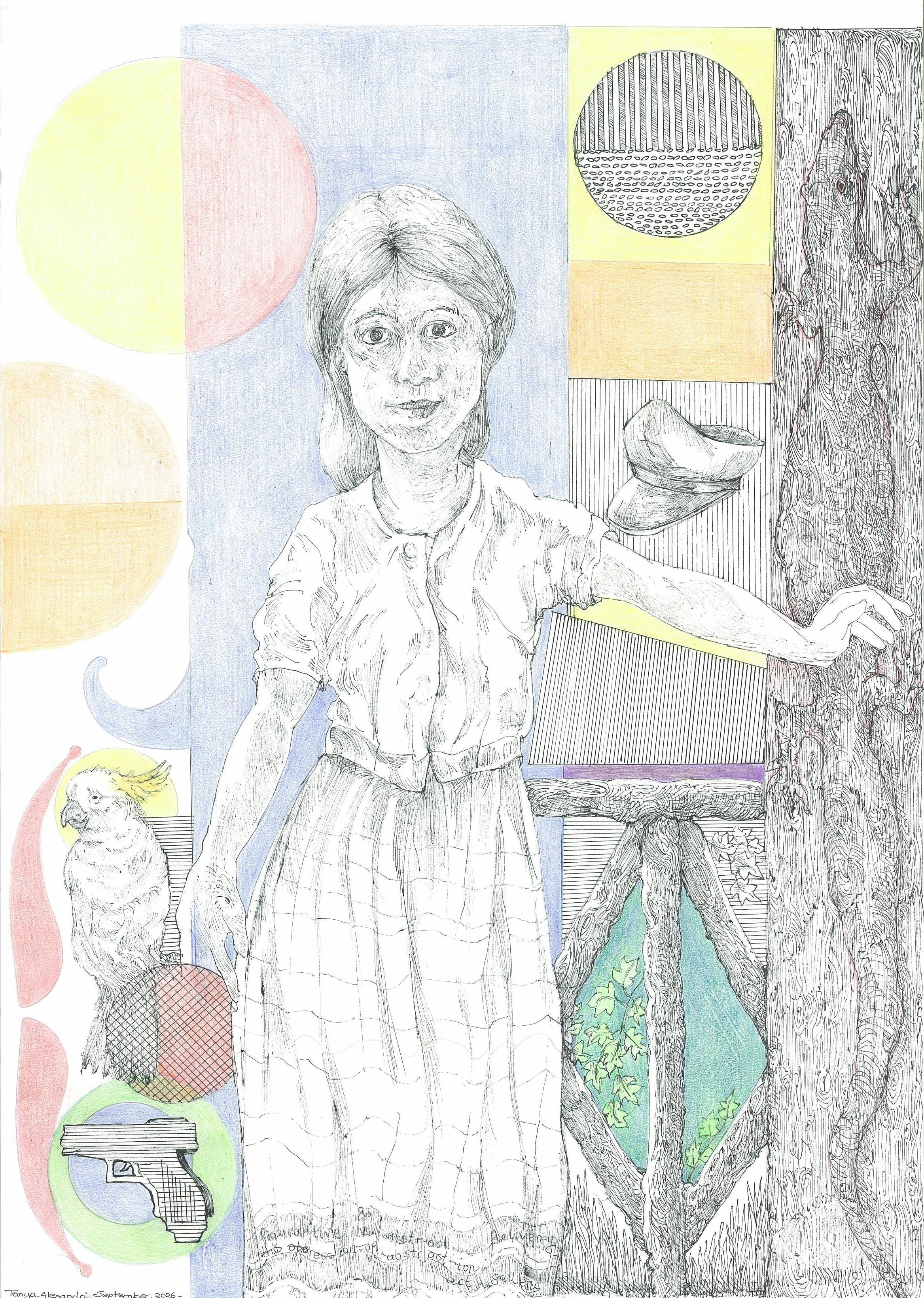
 Parrots have fascinated humans and lived beside them for millennia, and in the past they were considered exotic, luxury items and status symbols, often kept by nobility. Parrots hold significant symbolic importance in many religions and cultures. In art they sometimes represented wealth, were often depicted with women, and in Chrisitan art the parrot sometimes functioned as a symbol for Mary. One well known painting is Jan Van Eyck’s painting of a Madonna with Jesus holding a green parrot. It also symbolized other things as in the Greek orthodox icon of the monk St Porphyrios, who is depicted with a parrot on his shoulder. Furthermore, parrots have been literary fixtures, and more recently have starred in films. In psychology, too, the parrot has been used as a symbol or metaphor for various ideas. For instance, in Jungian psychology a parrot may represent “parroting behaviour,” a.lack of a true or more authentic identity, and may reflect the fear of not being one’s true self or the adopting of the opinions, beliefs, narratives and expectations of others.
In cognitive behavioural therapy / CBT the image of a parrot on one’s shoulder can represent the inner critic, as if literally having someone on one’s shoulder persistently whispering critical evaluations and negative self talk. The “Poisoned Parrot Metaphor” is a tool to work with negative self talk through cognitive defusion, which suggests recognizing that the thought is often just an unhelpful inner voice or automatic inner chatter, and rather than mistaking it as the absolute truth, simply acknowledging it and creating some distance from it. In behavioural psychology and in education “learning parrot fashion” implies rote memorization not deep comprehension or long term retention. In Greek we have a verb παπαγαλίζω, which translates into “to parrot” for this kind of learning or for mindlessly repeating things without truly understanding them. Finally in family systems or relational psychology it represents the emotional mirroring, the absorbing or internalizing of others’ emotional states because parrots that live with humans, being highly social, emotional and empathic creatures, can mirror the emotional state of their environment, and can even resort to self destructive behaviours like feather plucking when they are stressed. Pepperberg writes that parrots can get quite psychotic and often engage in over preening and plucking feathers when they are distressed.
Before I delve into the book I will tell a personal story of how I came to suspect that parrots are capable of more than simple mimicry. Over two decades ago I agreed to bird-sit for one of the teachers working at the language school I had at the time. Michelle had come to the island with her Greek fiancé, Kostas, who had two exotic birds, an African grey parrot and a smaller bird. They were to get married in the summer after the school year was over, and when the time came they needed people to take care of their pets. So one afternoon they arrived with two cages and some bird food supplies at my door, and all seemed fine until they left and a despondent parrot started calling out his owner’s name on and on over the next two days. It was heartbreaking to witness this small creature’s distress and the intensity of his missing his owner. Luckily, he didn’t lose his appetite nor did he engage in self destructive behaviours, and he soon adapted to the new situation. In an attempt to soothe what seemed like separation anxiety or grief I talked to him frequently and spent as much time as I could in the same space with him. He soon began to trust me and let me scratch his head and tickle his neck, which he seemed to like a lot, so much so that he got into the habit of pressing his little head against the railings of the cage more and more frequently. I responded every time I saw him, and while doing this I would whisper “I love you,” and after a few days he too began to say “I love you,” especially after he had received his dose of scratching.
He also liked to nimble the tips of our fingers and displayed preferences and emotions, especially jealousy, when I patted the dog, for instance. He would show his displeasure by making squawking sounds or repeating the dog’s name in a shrieking manner. However, if I left them alone, he would call his name in a softer tone, sounded more like me, and the dog would come and sit by his cage. At the time I hadn’t read anything about parrots’ cognitive or emotional capacities, but my experience with him showed that something more was going on then sheer mimicry. During the few weeks he spent with us he picked up words and short phrases, and the most fascinating of all was how he mimicked piano note sounds, and each time my son sat down to practice he would accompany him producing similar sounds.
When the time came for him to go home we all felt we would really miss him, me more than the others, but we were also a bit relieved because after a while he got into the habit of calling out “I love you” or other things, very early in the morning, irrespectively of the piece of cloth I was advised to place over his cage. Maybe I had spoilt him a bit, over responding to his ever increasing calls for attention. We also believed that he would be happy to be back with his owners, but when Michelle and I spoke again, she told me that the bird seemed somewhat depressed, had no appetitie, and kept repeating all the things he had picked up, and even sounded like me. Pepperberg writes about how parrots cannot only speak clearly, but also sound almost identical to their owners and how Alex had picked up her own accent.
The book I’ll be discussing today is about a human and a bird pioneer, who opened a window into the hidden world of animal minds, African Grey parrots in particular. Pepperberg’s book is a moving memoir, in which she tells the story of her extraordinary relationship with Alex, an African Grey parrot, who demonstrated a remarkable ability to communicate, understand complex ideas, and learned over a hundred words in his relatively short parrot life. He displayed linguistic capacities and problem solving skills and was capable of thought and intention, things believed previously to be exclusive to humans. Previously to Pepperberg’s research birds were not believed to posess potential for language and consciousness, It was believed that rather than being intelligent, parrots simply mimicked human sounds better than other birds; however, Pepperberg and her assistants proved that even though an African grey parrot has a shelled nut sized brain it has advanced cognitive, mathematical and emotional capacities, similar to those of primates or six year old human children, no small achievement for so small a brain. Grey parrots have the potential to learn hundreds of words, understand concepts like numbers, colours, shapes, size, and zero, and can display emotional responses like joy, fear, grief, irritability, jealousy, and so on.
Pepperberg begins her narrative at the end with the premature death of Alex, who died at the age of 31 [African Grey parrots can live up to 60 years in captivity]. The evening before Alex died when it was time for Pepperberg, to leave work, they had their ususal exchange of words.
Alex said to her: “You be good. I love you,”
“I love you, too,” she replied.
“You’ll be in tomorrow?” Alex said.
“Yes,”she said, “I’ll be in tomorrow.”
Alex’s death brought a lot of media attention, a great outpouring of personal emotion and public recognition and torrents of messages and letters from people from all walks of life, as well as, her own realization of how deep her bond and love for Alex was. She writes: “the sense of loss, grief, and desertion that tore viscerally at my heart and soul at the passing of my one-pound colleague and companion of three decades was of a degree and intensity I had never anticipated, nor could have imagined…… I have never felt such pain nor shed more tears….”
Pepperberg takes us back in time and back to her childhood. She was an only child and she lived with her first-generation Americans parents. Both her parents had been through severe deprivation growing up and her father had expereinced war trauma. Her mother, she writes, was rather distant and resentful about giving up work to become a housewife. Her dad taught elementary school during the day, studied thanks to the GI Bill for a master’s degree at night, and took care of his sick mother, which meant she didn’t see him much. He spent the little spare time he had sculpting clay figures and tending to his flowers in boxes and pots. There were no other children in their Brooklyn neighbourhood and so she spent a lot of time on her own and felt she was a little awkward socially. Being bright she was also accelerated a couple of grades, but being surrounded by older kids made her feel even more socially inept. Her first encounter with birds took place at the age of four, when her dad gave her a baby parakeet, a budgie, as a surprise gift to keep her company. Later when they moved house he put up a bird feeder so they could extend bird-watching throughout most of the year. She describes how birds became her playing mates. One of her various pet birds enjoyed sitting on the typewriter carriage while she banged the keys, “jerking unsteadily along with each hammer stroke,” another game she played with him was sorting out and messing up her mother’s button collection.
As she grew up she assumed she would pursue a career in the biological sciences, her dad had definitely encouraged her in this direction because of his own interests and his own dreams to be a biochemist, which was never realised due to the Depression and World War II., but she was hooked to chemistry. She was advised to apply to MIT and was accepted at the age of sixteen, which brought its own difficulties in terms of understanding how to live away from home and how to conduct a social life. In this high-pressure academic environment Charlie Bird was now her companion and solace. At MIT she became enthralled not only with theoretical chemistry, but also with David, a graduate student, who later became her husband.
Pepperberg also chronicles the events that led her from an academic life in theoretical chemistry to a career in animal communication research. After MIT she applied and was accepted at Harvard to do theoretical chemistry, an excessively male-oriented environment at the time. She aslo got engaged to David. They faced financial struggles, which got worse when the house they were living in with all their belongings burnt down and they found themselves homeless and without possessions. Luckily, David’s post doctoral adviser took them in at his house in return for their helping with chores around the house and looking after his two sons. It was there while watching documentaries and other educational programmes that a new world opened up for Pepperberg. There was the work of Jane Goodall; European researchers had won the Nobel Prize for their studies in some aspect of animal behaviour, biologists were beginning to think about animal minds and animal thinking. It was at that point that Pepperberg realised that she was “prepared to throw aside years of university work, of deep commitment and effort to studying chemistry as a career path, and embark on a venture for which [she] had little knowledge and no training.”
A professor in Harvard’s biology department, she writes, was able to orient her and that’s how she learnt about the pioneering work on human-chimp communication. She realised that no one was working with birds and that it would also be easier because they could learn speech, the African Grey parrot, in particular, learned most easily and was the clearest talker. Pepperberg explains that at the time the prevailing psychological dogma known as behaviorism, viewed animals as automatons, with little or no capacity for cognition or thought, and biology was dominated by theories claiming that much of animal behavior was innately programmed. But this, she says, was contrary to her gut instincts and common sense, and felt that it was obvious that both communication and learning to communicate is a social process. At the time she came across a paper by the German ethologist Dietmar Todt about what he called model / rival program of training, where instead of having one trainer, an animal has two, and where trainer B is the “model” for the animal subject and its “rival” for the attention of trainer A.
This is the model Pepperberg adapted for working with Alex and also the model she found the most effective. The idea was that he would learn in a social context. She and her assistant would take turns asking each other about an object’s label, with Alex observing. Within just a few weeks, she writes, of beginning training, “Alex was indisputably using vocal labels to identify specific objects. He was not merely mimicking.” The firsr word he mastered was paper because he liked to chew paper and was often given bits to chew on. Soon Alex could identify objects he’d been trained to label like wood, hide and key, and over the years learned to identify over a hundred words. He learned to label colours, but seemed less interested in them perhaps, Pepperberg notes, because they all tasted the same, while the different objects had different tastes and textures. Through anecdotes Pepperberg describes his display of a variety of capacities and acquisition of new learning. For instance, he was able to correctly identify and name combinations of novel objects and colors, which in linguistics, is known as segmentation, which means being able to take pieces of two phrases apart and reassemble them appropriately. The Swiss psychologist Jean Piaget had argued that when children learn something new, they need time to assimilate it before using it with ease, Once they started to tape Alex’s solitary evening babbling, they found out that similarly Alex frequently “practiced” on his own a newly acquired word to perfection, even though earlier in the day he had completely failed to say it.
Uderstanding concepts, such as “matter” or material, color and shape, says Pepperberg, is a higher level of cognition, and that it was one thing for Alex to identify an object and say “four-corner wood,” for instance, but quite another for him to see a piece of red four-corner hide and correctly respond to separate questions such as “What color?” or “What shape?” because that required Alex to understand the concept of color and shape as categories. κατηγορίες. Another capacity he demonstrated at one point was the combination of parts of two different words to form a new word (blending). Alex had learned grape, banana, and cherry on his own, because they named everything they fed him. “Apple” was therefore going to be his fourth fruit label, but Alex stubbornly refused to say apple. Then, Pepperberg writes, “in mid-March 1985, he looked at the apple quite intently, looked at me, and said “Banerry.” They eventually worked out that he had combined ban (from banana) and erry (from cherry) probably because it tasted a bit like banana and actually looked like a large red cherry.
Alex was also capable of understanding the concept of same and different, which is fairly sophisticated cognitively. Pepperberg says that David Premack had already tested chimps, but all the animal had to do was indicate whether two objects were the same or different; however, Alex went a step further in their tests because he was able to tell her exactly what was the same or different: color, shape, or material. After that they moved on to relative concepts, such as size difference, and Alex got that, too. She worked on object permanence: the understanding that an object continues to exist even when it is hidden, a capacity that develops gradually in children over their first year, and Alex had a good grasp of this too and also had fun during the testing procedures. There’s also an interesting anecdote of Alex’s experience with the mirror and how he learnt the colour grey.
She worked on phonemes, the individual sounds that make up a complete word, training Alex to sound out phonemes, not because she wanted him to read, but to see if he understood that his labels / words are made up of sounds that can be combined in different ways to make new words, and Alex “did indeed understand that labels are made of subunits that can be used in different ways.” They needed to prove this scientifically, so they went about their usual way: “What color is ‘ch’?” and “What sound is purple?” However, Alex, Pepperberg writes, “leaped over where [they] were with his training, which was individual phonemes,” and sounded out the parts of a complete word. She also worked with Alex on recognizing and understanding Arabic numerals, and addition. Alex could indeed add, but could also grasp the concept of zero, whcih she claims is “a highly abstract concept. A label for zero entered Western culture only in the 1600s.” Moreoevr, Alex’s use of “none” in one case was entirely his invention. He also grasped “none corner wood,” for circle. And when it came to what is called equivalence, in other words understanding that the squiggle that is the Arabic numeral five or six represent five or six things, he figured it out himself, with no previous training.
In 2005 Peperberg teamed up with Patrick Cavanagh, a psychology professor at Harvard to explore if Alex literally sees the world as humans do and if his brain experiences the optical illusions the way our brains do. Pepperberg also collaborated with Linda Schinke-Llano, a specialist on second-language acquisition in humans, looking at how Alex’s learning of English words illuminated that process. Her work also explored questions like, how Alex made sounds that resemble words when his anatomy is so different from humans in his vocal tract, his tongue, his possession of a beak, and the absence of lips. Special equipment was used to record and analyze the sounds he made when answering questions, and the sonograms of Alex’s vocalizations, looked very similar to what she would produce, showing that human speech is not as unique as it has long been considered, and also raising questions on the nature of language and how it came to be what it is in humans.
Through many anecdotes Pepperberg also describes her beloved feathered colleague’s personality and his display of emotions and intentionality. Alex loved to dance, played jokes on her and others, and was playful and affectionate, but he was also bossy and demanding, if not promptly rewarded, and during their first year together, he had several ways of communicating displeasure or negativity of some kind. Once he acquitred a functional use of “no,” he would use it to get his own way, If for instance Alex said “Want grape” and was given another fruit, he’d spit it and repeat insistently, “Want grape” until he got one. He also got bored and irritable when asked to repeat things during experiments, which is to be expected, because “science needs tests to be done over and over again—actually, sometimes sixty times or more, before the answer has statistical legitimacy, and before scientists will take you seriously.”
Once when Pepperberg had shouted at him over something, he cowered a little, looked at her, and said, “I’m sorry…I’m sorry,” which he had obviously learnt from her when she had previously said sorry to him or others. She poses the question of whether he could feel remorse, or whether it was simply a means of defusing anger, but either way, it’s still an effective mode of communication. He picked up a lot more phrases in passing, which he used appropriately, like when he told her one evening, when she was especially upset and distressed after a work meeting, to “calm down.” At one point Pepperberg provides a poignant anecdote of when Alex had to stay in hospital for a while. Everyday when she visited he would say, “Come here. Wanna go back,” “Pay attention. Come here. Wanna go back!” Alex also liked to spend time alone in his own spaces, had his own daily activities, toys he played with and things he liked to do. For instance, he liked to go on an excursion to a room near his lab to look at a tree and watch the birds. At least two or three times a week, Pepperberg says, Alex would say “Go see tree.”
Alex also displayed possessiveness and jealousy of her attention towards other parrots and people, and of course could be territorial and competitive. Pepperberg writes, “Territoriality is natural in Greys, especially in dominant birds, as Alex unquestionably was…” and that “Once Alex had learned how to label objects and request things, he relished the control it gave him over his environment, the ability to manipulate the people around him…..” And although initially, he was skittish around strangers, he learned that by asking for things he was in control of his environment, simply because when he asked for things they were given to him and he liked that. While conducting an experiment she further realised that while the younger bird relied on his native Grey intelligence to get the nut he wanted, and thus, pulled the string to bring it closer, Alex, in contrast, relying on his entitlement, refused to pull the string and insistently asked for what he wanted, expecting to get it.
She describes the introduction of other young parrots into the lab and how Alex’s domineering personality at times would hinder their training or testing procedures. Alex would immediately shout out a correct answer to a question while Alo or Kyo were hesitating or he’d admonish them, “You’re wrong,” Working with these two birds Pepperberg also realised that birds like people come with psychological baggage depending on what they’ve experienced with previous owners, and also that one of the two birds displayed a bird version of ADHD. This lead to her decision to get a young bird, to literally raise it, but raising this little bird, she says, was like no other bird experience she had ever had because she had to be a parent substitute to him. All the parakeets she’d owned as a kid had been fledged and weaned, but now they had to hand-feed Griffin several times a day, and carry him around with them most of the time because he needed their warmth and was totally dependent on her and her assistants for survival. Her plans to have Alex act as a parental figure and tutor to Griffin worked out to a certain degree only, and Griffin usually learned more efficiently when he had two human tutors rather than a human and Alex, who would often give the right answer when Griffin hesitated, tell him, “Say better” when he did get it right, or simply confuse him by providing a list of wrong anwers.
The book traces their journey together through thick and thin.
Pepperberg and Alex stayed together through many difficulties for three decades: long working hours, financial sacrifices and insecurity, disappointments, a nomadic existence, moving from one university or lab to another, trying to get recognition and funding for research, hoping to find a permanent home, struggling to gain acceptance for what was viewed as an unconventional study, and also, survive antagonism and battles in the academic world, Alex’s illness and needing to organise a fund-raiser to help out with the cost of his treatment, a period of being without work and not having a place to house the birds, and prejudices. The subject of language, she comments, had always been a contentious topic, scientifically and emotionally for both some scientists and laypersons because spoken language had long been held sacrosanct and as being uniquely human, a defining character of what separates humans from all other creatures. Also, as she comments, she was “outside the comfort zone of mainstream science, too edgy in the questions I was asking, impossible to slot into neat categories…” because although she was part of psychology, linguistics, anthropology and animal behavior, she couldn’t be shoehorned into any single one.
In 199I she became an associate professorship in Arizona. She writes it was the first “real job” of her unusual career and the first shot at security that tenure conferred. She fell in love with the place and bought a house in a rural area outside the city. In 1991 Pepperberg also established the Alex Foundation, a non-profit organization to raise money to support all this work and for getting word of their discoveries to a wider audience. She also published The Alex Studies, a book with Harvard University Press. At the end of that decade she received an invitation from MIT research lab because at the time several people there were studying computers as learning systems, and hoped to use her parrot studies as models. After a painful separation the first year she was invited to work for MIT research lab, which was quite hard on Alex, Alex and Griffin arrived at the Media Lab, in September 2000.
During that period she had a lot of resources to study ways that technology could keep domestic parrots happy and stimulated during the hours their owners were at work in order to avoid stress. As she puts it “It is like putting a four-year-old kid in a playpen in the morning and leaving him there all day by himself.” Also parrots have not been domesticated for thousands of years like cats or dogs, they are wild animals, and when we shrink their world to the size of a cage or even a room they get distressed and often exhibit self destructive behaviours. She studied whether the three parrots she was working with, Alex, Griffin and Wart, who belonged to the MIT lab, would interact with gadgets, and would for instance, be able to select between modes like pictures, videos, music or games, using a joystick. Wart came to be quite proficient at surfing all the availabilities, as did Alex, who showed little interest for images, but loved the music and whistled along with whatever was being played, but Griffin showed little interest.
This memoir reflects her journey with Alex over three decades and it contains the love, the loss, the grief, the insecurity, the accomplishments, the recognition, and the knowing that the world is populated with thinking creatures, and that animals are far more than the mindless automatons that mainstream science held them to be for so long. Pepperberg writes, “a vast world of animal cognition exists out there, not just in African Grey parrots but in other creatures, too. It is a world largely untapped by science.” It also explores philosophical implications of acknowledging intelligence in non human animals and appreciating all life’s interdependent existence on the planet, and how her own and others’ pioneering research into the intellectual capacities of birds and non human animals, have challenged long held assumptions about animal cognition. She recounts the lessons that Allex taught her over the years. He showed her that his little bird brain was conscious in some manner, that is, capable of intention. He also taught her that humans are a part of nature, not apart from nature, a notion that has given us permission to destroy or exploit every aspect of the natural world without considering consequences for future generations and other species.Towards the end of the book she writes, “Alex’s sudden, unexpected departure left me in awe at his achievements and wondering what else he would have done had he stayed. He left at the height of his powers……. Indeed, he had given us a glimpse of another world, one that had always existed but remained beyond our view: the world of animal minds.”